American sculptor born in 1941. Her work is usually wax paintings and poured latex sculptures.
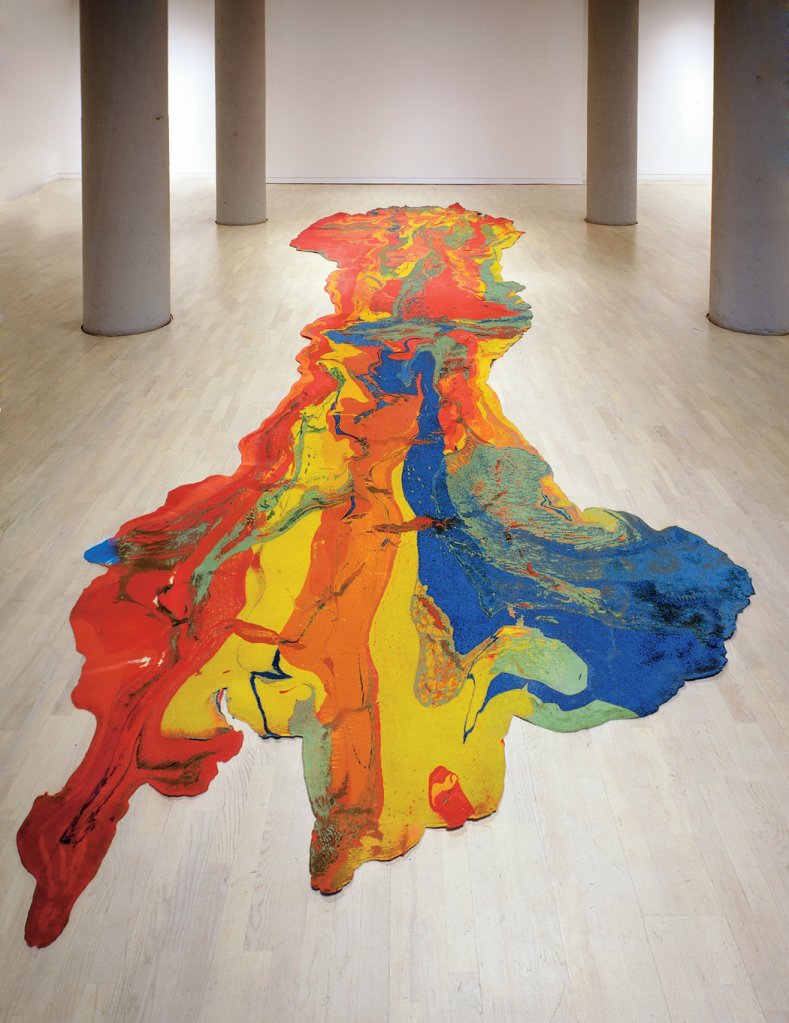
Benglis started as an Abstract Expressionistic painter, inspired by the gestural style of the traditional paintings. However, she claims she to want to ‘redefine’ what painting means. This is how she began using different materials and mediums to mimic the gestural style of painting but within a sculptural body. Benglis is interested in capturing fluid and motion in her solid sculptors, playing and juxtaposing from the hard and the soft, the fluid and the solid state of matter. she allowed the process of making to dictate the shape of her finished works, wielding pliant matter that “can and will take its own form.”
Often working in series of knots, fans, lumps, and fountains, Benglis chooses unexpected materials, such as glitter, gold leaf, lead, and polyurethane. In her use of candy colors, glitter and other craft materials, she distanced herself from the serious, brooding color and macho materials used by her contemporaries. In doing so, she sought to question traditional gendered distinctions in art, above all the opposition between art and craft.
Benglis took inspiration from Jackson Pollock’s dripping methods in painting, but took to a new level, coming away from the 2D canvas of flat surfaces. She began pouring directly onto the floor, removing the use of the canvas. This had a feminine approach to the method that Pollock had first introduced. Rejecting vertical orientation—as well as canvas, stretcher, and brush—the “pours” push conventions of easel painting to the point of near collapse. Examples of her work that had this feminist approach are Fallen Painting (1968) and Contraband (1969). Both of these floor works had the essence of invoking “the depravity of the ‘fallen’ woman” or, from a feminist perspective, a “prone victim of phallic male desire”. (Jones, Amelia (1998). Body Art/Performing the Subject. Minneapolis: University of Minnesota Press. pp. 96–97)
Also, being one of the few female artists of the 1960’s, Benglis was highly involved and interested in feminist art, challenging the male-dominant minimalist movement. She was highly intrigued by mediums that were uncorrupted by male artists at the time, and started working in videography and photography to produce art that favored the feminists.
She also used media interventions (such as a well known ad placed in Artforum in 1974, showing the artist nude with a dildo between her legs) to explore notions of power and gender relations. Benglis was initially refused an editorial space in Artforum before paying for an advertisement within the art magazine, of a full page photograph of herself in the nude, wearing glasses and holding a dildo between her legs.

 Sarah K Obina