Born in Mexico City in 1967
His career began as a political cartoonist and he continues to incorporate witty humor into his work. His work ranges from large-scale installations of simple objects from everyday life. Often suspending the objects in a such a precise arrangement, they become witty representations of diagrams, solar systems, words, buildings, and faces. These shifts in perception are not just visual but also cultural, as the artist draws out the social history of the objects featured in his sculptures, films, and performances.
Recombining and disassembling mass-produced and vernacular artifacts, he charts the constellations of social, economic, and political forces that underlie material culture.
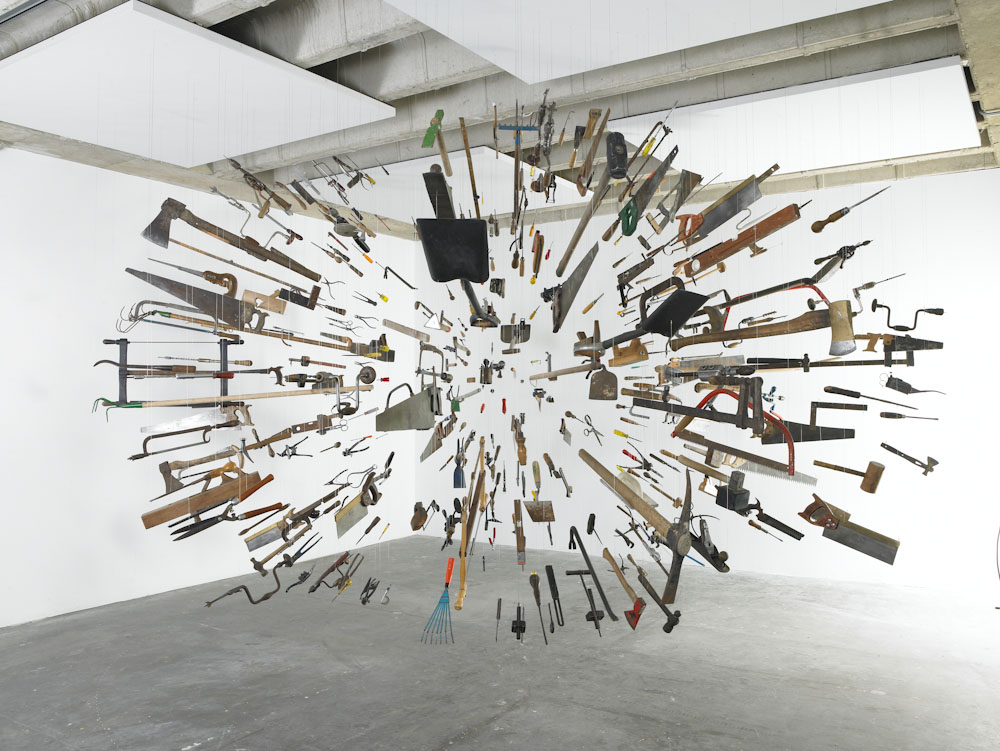 Controller of the Universe, 2007 – Hand tools, saws and other cutting instruments
In Controller of the Universe 2007, a collection of hand tools, saws and other cutting materials are suspended in a coordinated assembly to signify an explosion of a toolbox. Here, tools can be understood as symbols of humanity’s desire to shape and control the world, yet this purpose is ultimately subverted by the subjective ordering of the work’s components.
 Cosmic Thing 2002 – Entire Volkswagen Beetle 1983
Once again, in Cosmic Thing 2002, an entire Volkswagen Beetle is dissembled and suspended in all of its parts. Whilst depicting an explosion of the car from within , it also an act of dissection. The pervasive and popular Beetle is revealed as an emblem of political ideology and the inescapable reach of global capital.
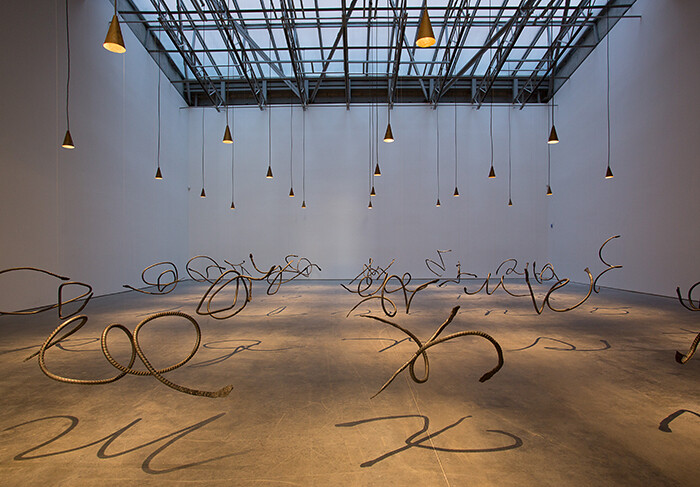 Harvest, 2013 – Steel sculptures, lamps, dimensions variable
The centerpiece of the show is Harvest (2013), a large installation of some twenty steel sculptures hovering mid-air and evenly distributed throughout the main space of the gallery. Thin shapes tracing lines in space, they read like corrugated tire irons crossed with cobras in suspended animation. Their appearance straddles the line between objects of human techné and organic shapes resulting from nonhuman forces, like the speculative first bone-tool in Stanley Kubrick’s 1968 classic science fiction film 2001. Cutting through an otherwise dimly lit room, the overhead lights illuminate each sculpture and cast high-contrast shadows directly onto the concrete floor, such that these three-dimensional shapes can suddenly be read as two-dimensional inscriptions on the floor. A short history of shadows might point in any number of directions: the allegory of Plato’s cave, or the Corinthian maid who invented painting by tracing a loved one’s shadow profile. More fundamentally still, it was the first index, sign, or metaphor that touched off whole new systems of representation against the earliest fire-lit, stone walls. As carriers of meaning, these objects are imbued with historical and epistemological obscurity, and the solemn, austere, and paleontological feel of the installation lends itself to this sort of speculative anthropological thinking.
 Sarah K Obina