21 October 2011 – 29 January 2012
This is a project of multiple video installations through which the idea of ‘madness’ is given a variety of interpretations. It is an experiment in audio-visual story-telling. Distinct from cinema, in the installation the ‘second-person’, the visitor, is in charge of making the stories through their own itinerary and combination of stories, portraits, and scenes on view.
Landscapes of Madness constitutes a voyage of discovery that can take any length of time, from several minutes up to several hours depending on your interest. But we hope all visits will be immersive experiences, leading up to engaged and engaging encounters. The exhibition offers experiences both familiar and unfamiliar. In a combination of shock, pleasure, strangeness and beauty, you make a journey through what is usually called “madness”. You wander through the spaces and keep encountering new forms of madness—some tragic, some humorous; some play-acted and some “really mad”. This raises the question that you are implicitly requested to ponder: are these people, and the people I encounter mad, do they play the fool, or am I too rigid to allow them to be sane; and what does the answer to that question say about me?
Mieke Bal (Heemstede, 1946) , a cultural theorist and critic, has been Royal Netherlands Academy of Arts and Sciences Professor. She is also a video artist, making experimental documentaries on migration and recently exploring fiction. Her interests range from biblical and classical antiquity to seventeenth-century and contemporary art, modern literature, feminism, and migratory culture.
Michelle Williams Gamaker (London, 1979) is a video and performance artist. Her work varies from single-frame portraits and installations to complex renderings of reality via documentary and fiction. The subtle and sublime potential of story-telling is at the root of her work.
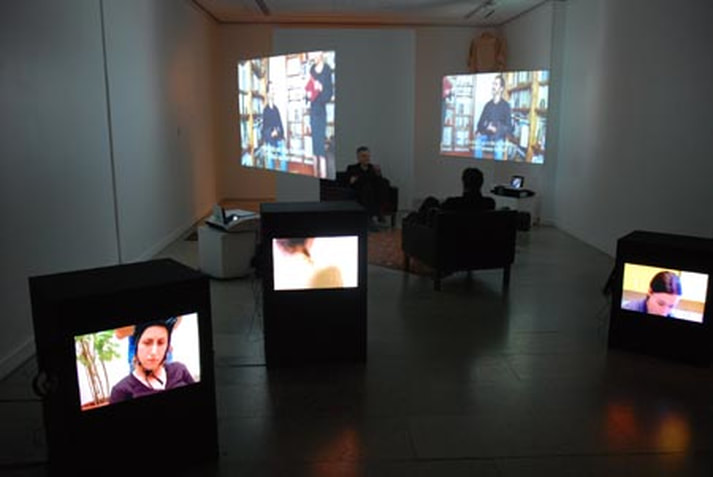
Françoise and Jean-Max sitting in The Space In-Between The author of the book from which our project originated and her husband are sitting in the 10-minutes two-screen projection installation “The Space In-Between”. Another serendipitous mise-en-abyme: Françoise appears in the left screen, as the analyst treating the homeless Herlat, a man traumatised by the war history of his family and his status as “ersatz Kind” – two siblings died before his birth. In the end, his problems are resolved. In the foreground the three-screen video sculpture “Office Hours”, showing brief interactions between patients and analyst.
A near-but-not-quite immersive experience of witnessing the dynamic and effect-laden process of an analysis. In the last part of the gallery, with two-screen back-projection, a domestic rug indicates the space of the psychoanalyst’s office where the “treatment” takes place. On both edges of the rug an arm chair is available for visitors to sit in and peek into the “office”. The chairs may be moved. This gives the visitor the freedom, but also the near-compelling need, to take a position. Memories of both analyst and patient circulate and sometimes seem to invade the present of the analytic event. As in Psychoanalysis on Trial, one can listen and look with either party, or shift from one position to the other. But this time we are in the privacy of the consultation room and witness the individual interaction between analyst and patient, This most dramatic installation stages a situation where indifference is an untenable position, and the identification with the patient is inevitable.Two-channel video projection (10:31:01)
Psychoanalysis on Trial Two-channel video projection (08:45:24)
The nature of the exhibition encourages the “audience’s consideration, contemplation and confrontation.”
Interactive Contemporary Art: Participation in Practice edited by Kathryn Brown pg19
 Sarah K Obina