Hito Steyerl is one of the artists that I have researched into for my project. I actually saw some of her works when I went to the Venice Biennale back in November 2019.
Her work concerns topics of militarization, surveillance migration, the role of media in globalization, and the dissemination of images and the culture surrounding it. Steyerl has pushed both the role and the label of fine artist, which is demonstrated through her tendencies and interests in engaging the presentational context of art. Her work is developed from research, interviews, and the collection of found images, culminating in pedagogically-oriented work in the realm of forensic documentaries and dream-like montages.
Exhibitions
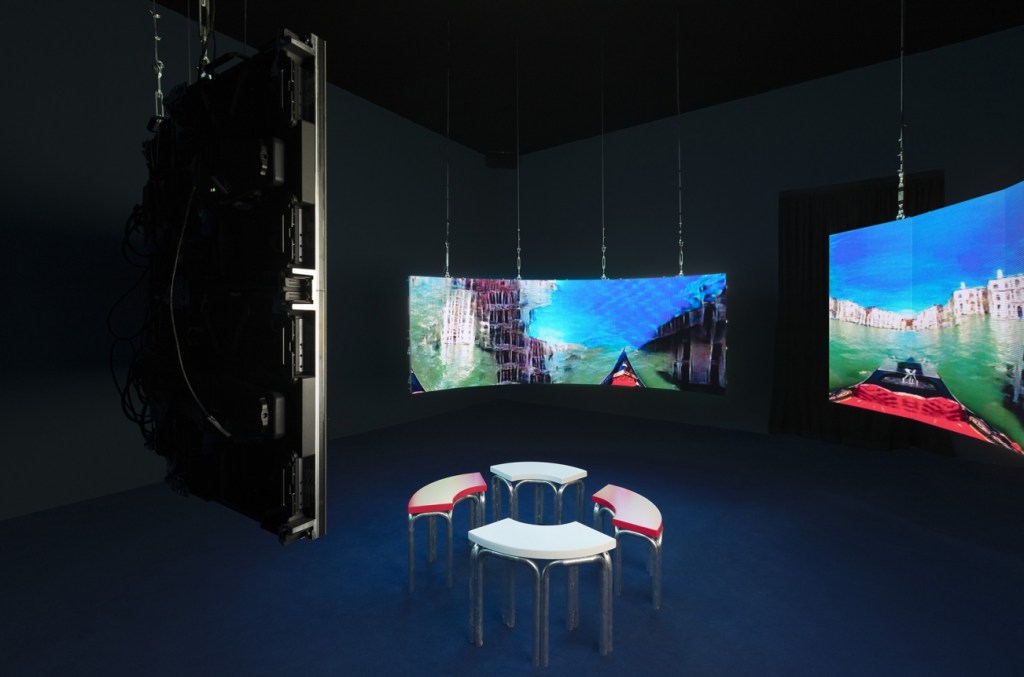
May You Live in Interesting Times , 58th Venice Biennale, May 11th – Nov 24th 2019
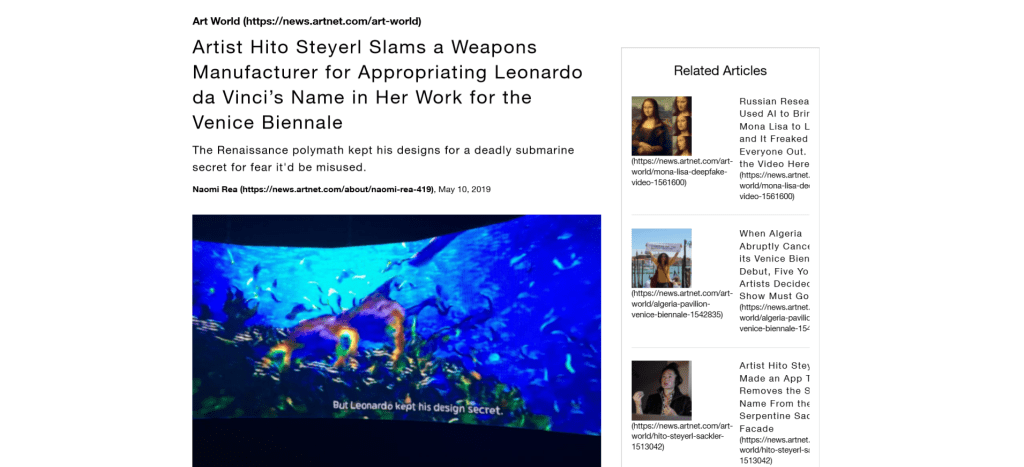
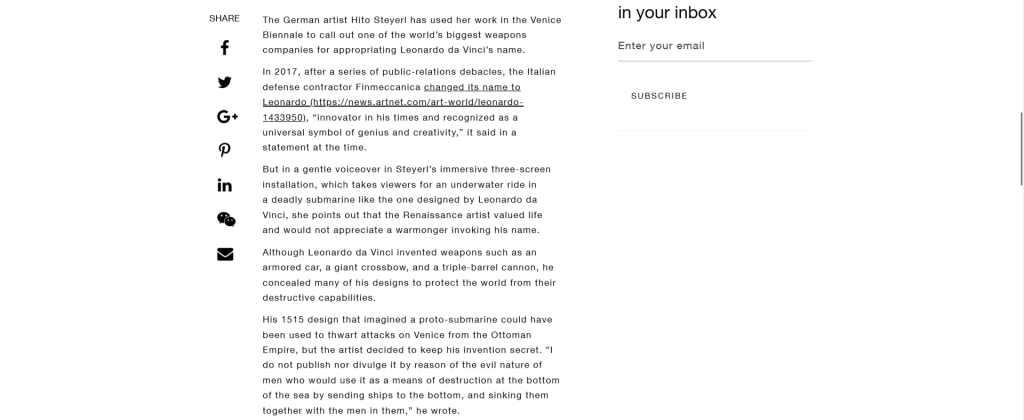
Leonardo’s Submarine , 2019Power Plants , Serpentine Sackler Gallery, April 11th – May 6th 2019
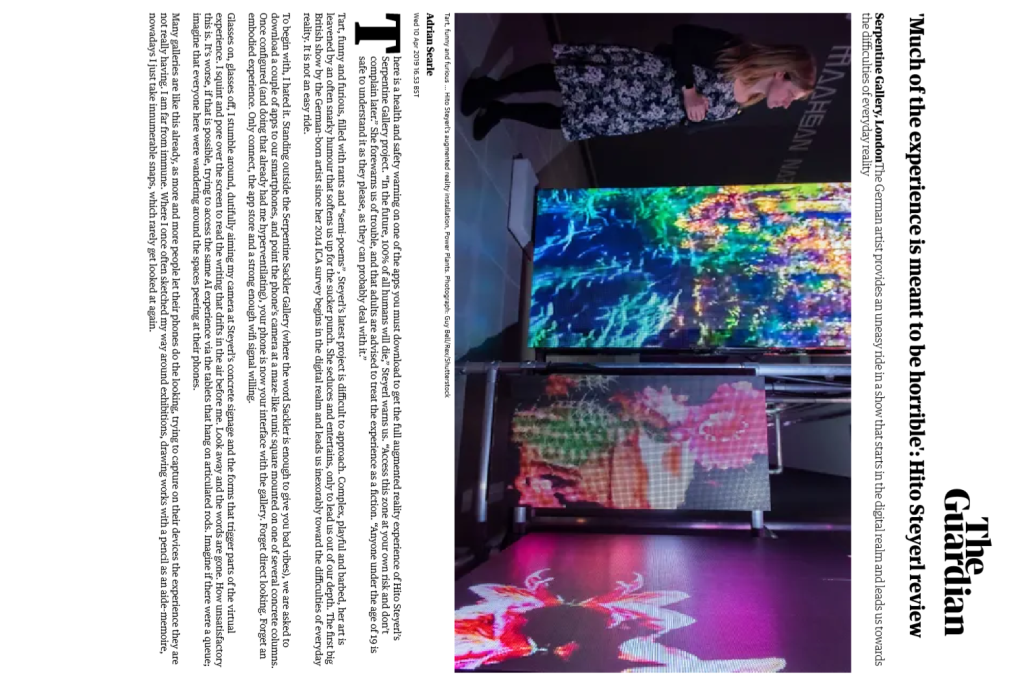
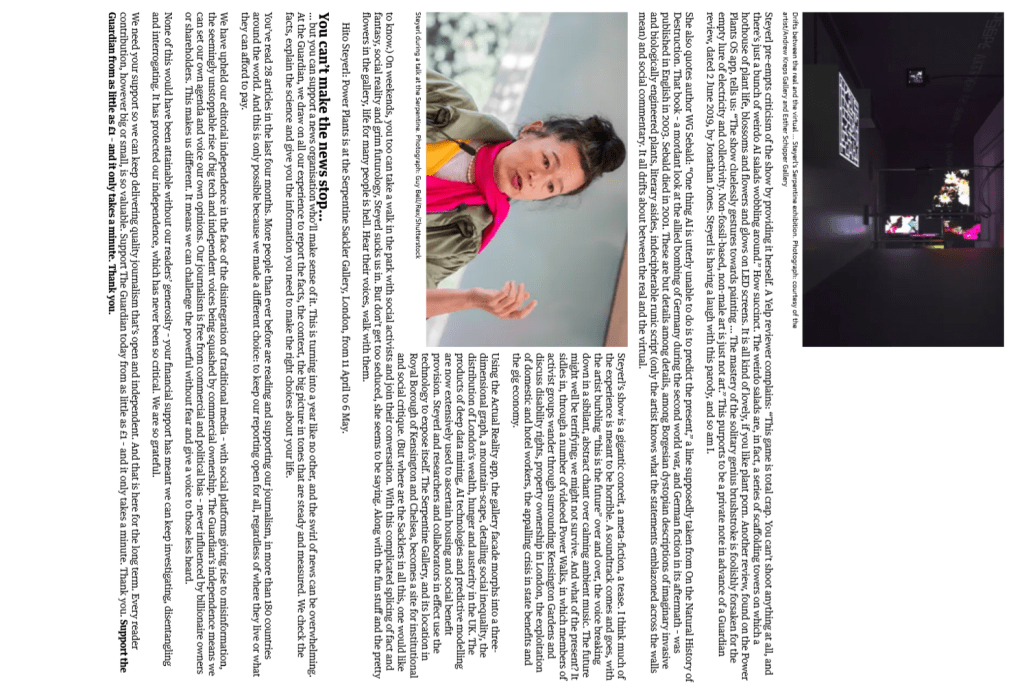
Power Plants , 2019Steyerl’s new project for the Serpentine Galleries considers power and inequality in society, mapping unequal wealth distribution in the communities surrounding the Serpentine which has been recorded as one of the most socially uneven areas in Europe. Visitors to the exhibition will see an augmented reality app designed to expand our social vision of some local communities to reveal what Steyerl calls Actual Reality, a series of guided neighborhood ‘power walks’, and a new video installation created using artificial intelligence trained to predict the future. Beginning with the premise that ‘’’power’’ is the necessary condition for any digital technology’, Steyerl considers the multiple meanings of the word, including electrical currents, the ecological powers of plants or natural elements, and the complex networks of authority that shape our environments.
Hello World―For the Post-Human Age , Art Tower Mito Japan, Feb 10th – May 6th 2018
How Not To Be Seen: A Fucking Didactic Educational .MOV File, 2013 How Not to Be Seen —a video by artist and critic Hito Steyerl—presents five lessons in invisibility. As titles that divide the video into distinct but interrelated sections, these lessons include how to: 1. Make something invisible for a camera, 2. Be invisible in plain sight, 3. Become invisible by becoming a picture, 4. Be invisible by disappearing, and 5. Become invisible by merging into a world made of pictures.1
A satirical take on instructional films , How Not to Be Seen features a mix of actual and virtual performers and scenes , which illustrate the strategies for becoming invisible, communicated in an authoritative narrative voiceover. In the fourth lesson, the narrator outlines ways of disappearing—including “living in a gated community” or “being a disappeared person as an enemy of the state”3 —while panning shots of architectural renderings of luxury living and public spaces, populated largely by computer-generated people, unfold across the screen.

 Sarah K Obina