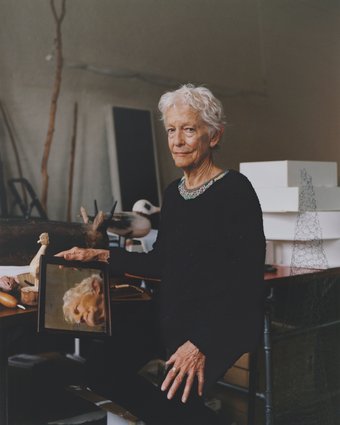
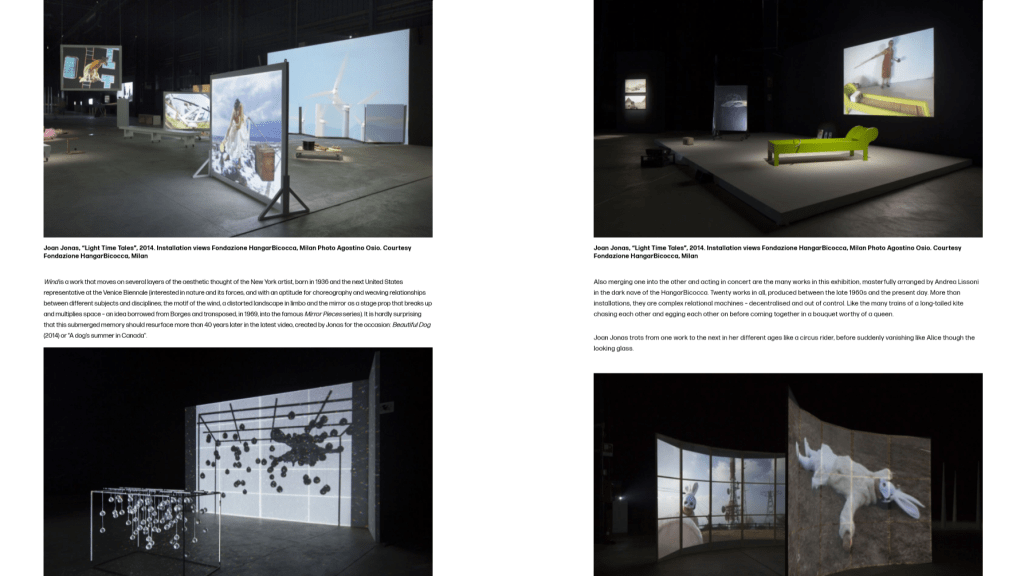
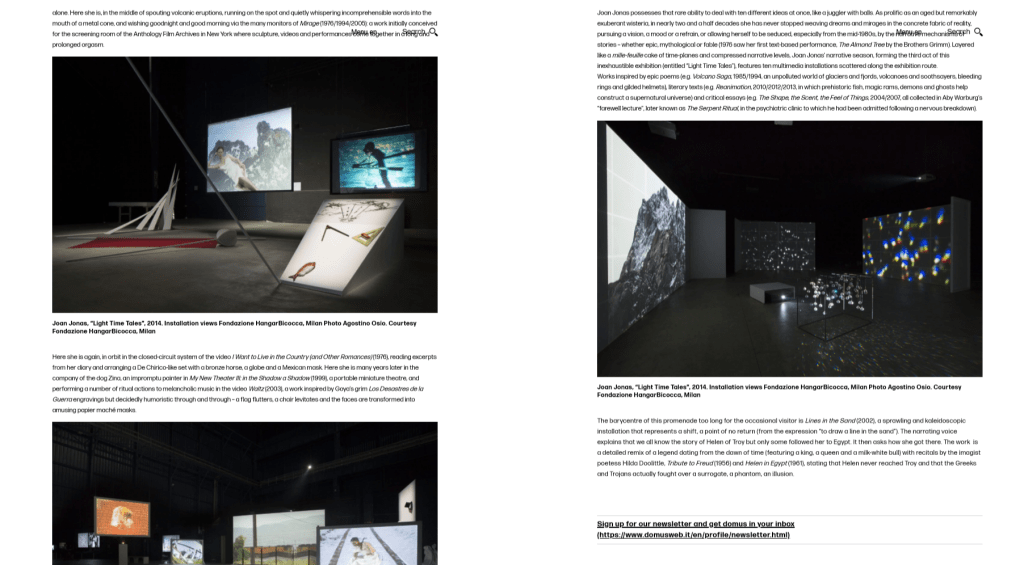
Jonas works as a Performance artist, but within this realm she incorporates drawing, dance, noise, video, travel, and at the same time introduces various sculptural objects, photographs, and props. She also interweaves a plethora of literary sources, including poems, myths, and fairytales, and as such, presents a highly complex and multi-layered private imaginative world to a public audience. The result is not usually simple, and often viewers feel overwhelmed, as though they cannot grasp any sense of linear narrative in the artist’s work. This is the honesty and integrity of a Jonas piece; she exposes without restraint that the self is fragmentary, anxious, and ultimately nonsensical. Since the early 1960s, and still today, albeit now with more institutional support, Jonas continues to examine her own identity, often in relation to other artists, cultural rituals, gender equality, societal gaze, and contemporary politics.

The work explores Jonas’s love of folklore and of fairy tales. The work is her reinterpretation of the tale of the same name taken from the first volume of the Brothers Grimm fairy tales. The story begins with a woman wishing for a child “as red as blood and as white as snow”, while standing by the juniper tree where she would eventually be buried. After giving birth to a boy, she dies and her husband re-marries and has a daughter. The step-mother, jealous of the step-son, kills him and serves his remains to his father in a stew. The son is then reincarnated into a bird and gets his revenge on his stop-mother by crushing her with a millstone. Upon the stepmother’s death, the son is reborn and reunited with his father and half-sister. This work became an important transitional work for Jonas, in that she uses paint, the practice of drawing, as well as narrative and text to represent the symbols and motifs in the story.
 Sarah K Obina