DOUGLAS GORDON

Exploration of expanded cinema. I’m interested in his methods of projections. He likes to explore different and interesting ways of displaying film, and I’m especially interested in his projections and video installations. He also likes to work with multiple videos within a piece. He exhibits videos together, and how they corresponds to each other within a space.

Working across mediums and disciplines, Douglas Gordon investigates moral and ethical questions, mental and physical states, as well as collective memory and self hood. Using literature, folklore, and iconic Hollywood films in addition to his own footage, drawings, and writings, he distorts time and language in order to disorient and challenge.

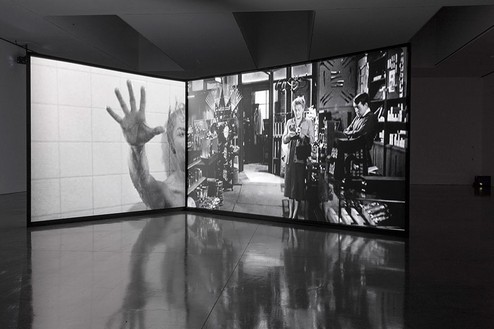
Douglas Gordon is a contemporary Scottish artist known for his ability to disrupt preconceived ideas about reality. Through his performances, installations, photography, and video art, Gordon readjusts scenes, tinkers with time, and appropriates cultural sources. His video projection 24 Hour Psycho (1993) decelerates the Hitchcock classic, prolonging its viewing for a day. For his sound installation, Something Between My Mouth and Your Ear (1994), Gordon played 30 songs that were popular during the months before his birth in a blue room. The artist has said of his practice that “the drive for me has always been to just push it a little bit more.”

For both films in “back and forth and forth and back,” Gordon has diffused the suspense and longing of their original plots, forming new conditions for viewing and absorbing their content. The film plays on two adjoining screens: on one, the film starts from the beginning, and on the other it starts from the end, so that for an unbearably brief moment (one twenty-fourth of a second), after waiting for twelve hours, the screens show the same sequence, the mirrored images resembling a giant, slow-moving Rorschach test.

A Divided Self I and A Divided Self II (1996)

A Divided Self I and A Divided Self II 1996 is a two-channel video installation displayed on two monitors. The work shows a close-up of two arms, one hairy and the other smooth, fighting each other on a bed sheet. In the first video the hairy arm has dominance, while in the second it is the smooth arm that defeats its opponent. As the videos develop it becomes clear that both arms belong to the artist, and that he is wrestling with himself. As the title indicates, the battle between the two arms suggests an internal battle between two halves of the self; however the source of the self-inflicted torment remains a mystery.

Inscribed within this tradition, A Divided Self I and A Divided Self II takes its title from the Scottish psychiatrist R.D. Laing’s pivotal and controversial treatise on mental illness, The Divided Self: An Existential Study in Sanity and Madness of 1960. In this book Laing argued that psychosis is not a medical condition but an outcome of the ‘divided self’ or the tension between the two personas within us: one our authentic, private identity, and the other the false, sane self that we present to the world.
Gordon often uses his own body as a ground for debate, exploring how contradictory human nature can be, and involves the viewer in the role of both confessor and witness to his investigations. For example, during the late 1990s, following the release of A Divided Self I and A Divided Self II, Gordon made a series of single and double screen videos, including Hand and Foot (Right) and Hand and Foot (Left) 1995–6, Left Dead 1998, Dead Right 1998 and Blue 1998, featuring parts of his body doing something or having something done to them. This series of videos displays a fascination with doubling, mirroring and reflection and portrays the artist turning against himself – wrestling, constraining and disfiguring his own body.


Leave a comment