Akomfrah (born 1957) lives and works in London.
Established a multi-layered visual style that has become a recognisable motif of Akomfrah’s practice.
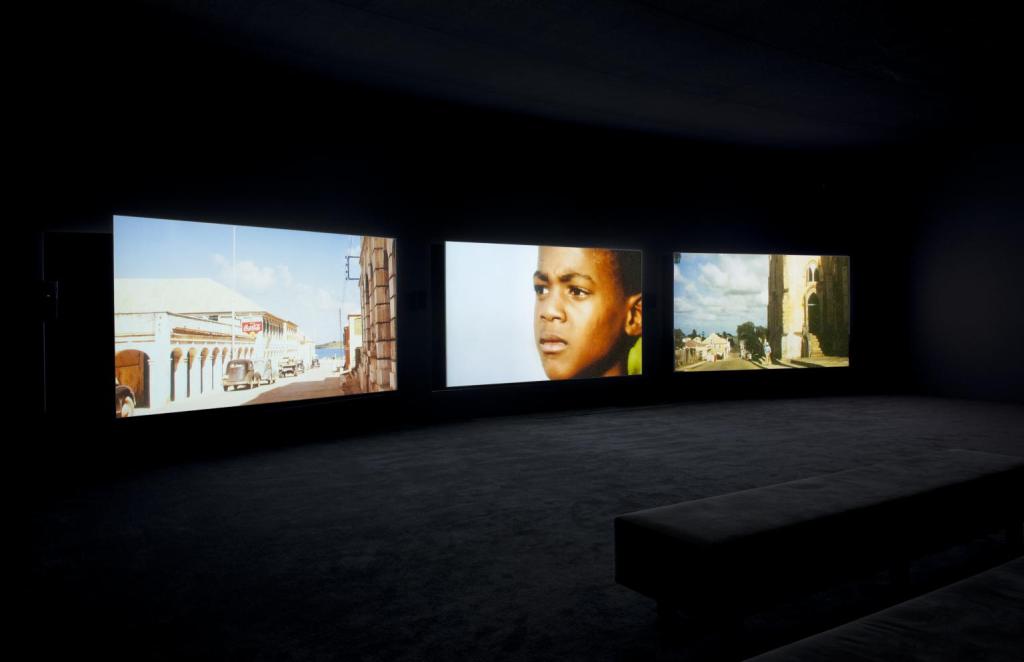
The Unfinished Conversation 2012 is a three-screen video installation that explores the multi-layered and ever-evolving subject of identity through an exploration of the memories and archives of the acclaimed British cultural theorist and sociologist Stuart Hall (1932–2014). The film is narrated in a non-linear format and unfolds over three screens, bringing up a variety of disparate footage simultaneously. This process examines the nature of the visual as triggered across an individual’s memory. Extracted images from news footage of the 1960s, alongside Hall’s personal home videos and photographs, are presented to merge the past, present and future.
Akomfrah weaves issues of cultural identity into the film using a wide range of reference, overlaying archive footage of Hall with a soundtrack made up of jazz and gospel music and readings from a wide range of authors, including William Blake, Charles Dickens, Virginia Woolf and Mervyn Peake. The title of the work refers to Hall’s exposition of identity. According to Hall, identity is not an essence or being, but instead a becoming that is part of an ‘ever-unfinished conversation’. The exploration of Hall’s memory is used with a variety of images intermingling with poetic soundscapes. https://www.tate.org.uk/art/artworks/akomfrah-the-unfinished-conversation-t14105
The six-channel video installation addresses climate change, human communities and the wilderness.
The installation immerses the viewer in the colour purple, a hybrid hue that combines the coldness of blue and the warmth of red, thus symbolizing the complexity and interdependence of every living thing. The montage of scenes of natural beauty creates a painful sense of the looming loss that humanity is facing. The reference to Tyrian purple, an expensive pigment which was initially created from a rare type of gastropod and became a symbol of might for Roman and Byzantine emperors, is a reminder of an early example of humankind’s exploitation of nature not for survival but as a means of acquiring wealth and demonstrating power.
Moving from images of birth to images of death, the narrative unambiguously points to the destructive nature of our activities on the planet, which is inevitably moving toward an ecological disaster.
In his panoramic views of nature’s most stunning landscapes, now altered by humanity, Akomfrah uses a technique popular in Romantic painting, placing solitary human figures at the center of his compositions. But if in German Romantic painter Caspar David Friedrich’s work anonymous figures confront the merciless and sublime forces of nature, in Akomfrah’s video they seem to embody the arrogance reflected in our vision of humankind as the center of the universe, ruling over all life on the planet. The irritating idleness of the figures in Purple reads as a premonition of the global consequences of humanity’s indifference toward its own ecological impact on the planet. https://garagemca.org/en/exhibition/john-akomfrah-purple
 Sarah K Obina