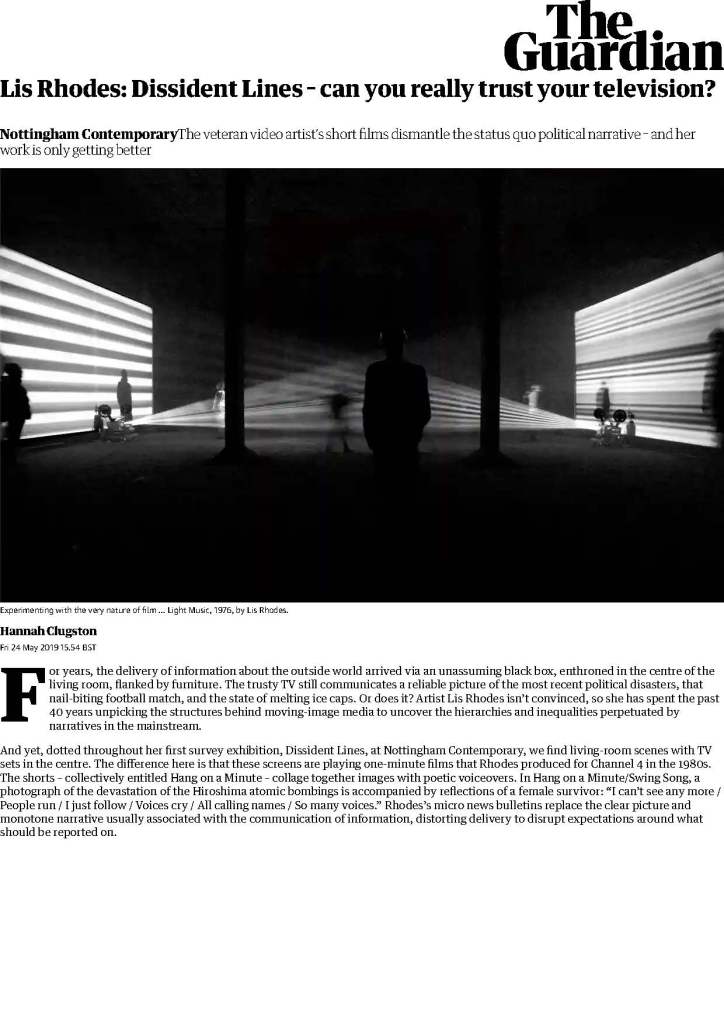
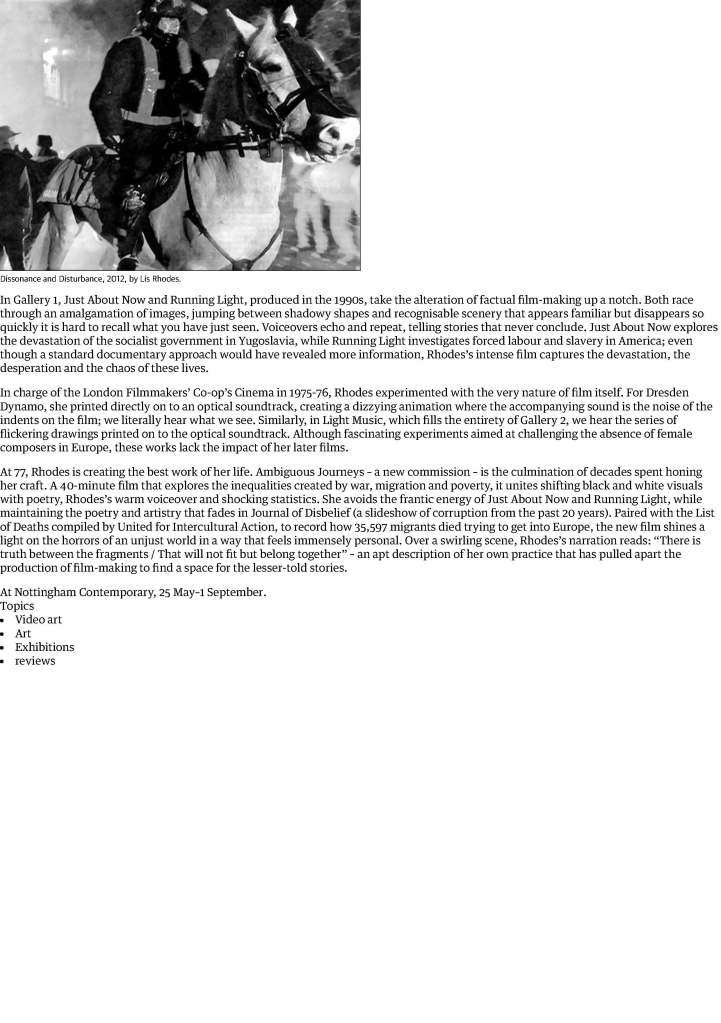
LIS RHODES

  • Born 1942
  • British artist and feminist filmmaker
  • Known for her density, concentration, and articulate sense of poetry in her visual works

Since the early 1970s, Rhodes has created radical and controversial art that challenges her viewers to question perspective of film through her work.

“reconsider film as a medium of communication and presentation of image, language and sound.” – Lis Rhodes: Dissonance and Disturbance

Lis Rhodes: Dissonance and Disturbance by Ann Jones (2012)https://mostlyfilm.com/2012/01/30/lis-rhodes-dissonance-and-disturbance/

  • all the work here seems to include aspects of collated or layered visuals
  • The complexity of the image making and the disjunction between sound and image – they often happen at different times: there are both long silences and periods when the screen is blank – make the work a lot more engaging and enjoyable to watch than that sentence makes it sound
  • What makes these films interesting is that, despite a strong political message, Rhodes mixes the harsh narrative of protest against war and injustice with poetry and her eloquent brand of image-making, itself highly poetic; documentary footage is mixed with text and softly layered and fragmented images

Lis Rhodes: Dissident Lineshttps://www.nottinghamcontemporary.org/whats-on/lis-rhodes-dissident-lines/

She has described it as ‘visual abstraction’, ‘an attempt to make a material connection between what is seen and what is heard.’

Rhodes’ works since the 1990s have been responsive to unfolding geopolitical events. These films are potent and provocative critiques of a range of issues, from women’s rights, domestic violence to nuclear power, from migrant labour to surveillance (Orifso, 1999). More recently, In the Kettle (2012) cuts between the bombing of the Gaza Strip in 2009 to contemporaneous protests in London. Rather than comprising separate projects, Rhodes has seen these works as belonging to a single enquiry.

Filmography/ works

  • Dresden Dynamo (1972)
  • Light Music (1975)
  • Light Reading (1978)
  • Hang on a Minute series (1983–85)
  • A Cold Draft (1988)
  • In the Kettle (2010)
  • Whitehall (2012)

CAMILLE UTTERBACK

Precarious (2018)

Precarious is an interactive installation that extends the historical practice of tracing human silhouettes with a mechanical apparatus on a backlit screen, by instead “tracing” gallery visitors with contemporary digital tools. Utterback uses a ceiling mounted depth camera to record peoples’ silhouettes as seen from above. Her software then continually interprets and redraws this data, rendering the silhouettes not with the stark fixedness of paper cut outs, but as tremulous outlines of bodies moving through time. The painterly aesthetic of Precarious builds on the algorithmically generated visual language which Utterback has refined over many years via her custom coded interactive drawing systems.

Entangled (2015)

In Utterback’s Entangled installation, participants interact with imagery projected onto two sides of a set of translucent scrims, which hang in the center of the installation space. Movements in the interaction areas on each side of the scrims cause imagery to appear, move, and disappear on the corresponding side’s projection.

The title of the work, Entangled, refers to the merging of participant’s physical traces on scrims in the installation, and also our ongoing emotional entanglement with digital systems in our lived environment.

Liquid Time Series (2000-2002)

In the Liquid Time Series installation, a participant’s physical motion in the installation space fragments time in a pre-recorded video clip. As the participant moves closer to the projection screen they push deeper into time—but only in the area of the screen directly in front of them. Beautiful and startling disruptions are created as people move through the installation space. As viewers move away, the fragmented image heals in their wake—like a pond returning to stillness. The interface of one’s body—which can only exist in one place, at one time—becomes the means to create a space in which multiple times and perspectives coexist. The resulting imagery can be described as video cubism. To create this imagery Utterback’s software deconstructs the video frame as the unit of playback. This piece destabilizes a basic premise of time based media—that the unit of recording is also the unit of playback.

The unexpected permanence of certain elements (and the transience of others) hint at how both personal and cultural memory have a physical component subject to the unpredictable nature of decay.

PIPOLOTTI RIST

Pipilotti Rist is a Swiss contemporary video artist. Best known for her vividly colorful work exploring the female body—namely her own—Rist’s work engages in lighthearted play, frequently combining a camera-specific aesthetic and technique with a message of social critique or commentary. “When I close my eyes, my imagination roams free,” she has explained. “In the same way I want to create spaces for video art that rethink the very nature of the medium itself. I want to discover new ways of configuring the world, both the world outside and the world within.” Born Elisabeth Charlotte on June 21, 1962 in Grabs, Switzerland, the artist studied at the University of Applied Arts Vienna, before studying video at the Schule für Gestaltung in Switzerland. Gaining acclaim for her work in the 1997 Venice Biennial, during which she received the Premio 2000 Prize, Rist continued her upward trajectory of international recognition, teaching at the University of California Los Angeles with Paul McCarthy in 2002–2003, and being awarded the Joan Miró Prize in 2009. She currently lives and works between Zurich and the mountains of Switzerland.

For Rist, showing vulnerability is a sign of strength on which she draws for inspiration. With her curious and lavish recordings of nature (to which humans belong as an animal), and her investigative editing, Rist seeks to justify the privileged position we are born with, simply by being human. Her installations and exhibition concepts are expansive, finding within the mind, senses and body the possibility for endless discovery and poetical invention. ‘Pixel Forest’, 2016, made from 3,000 thousand LEDs hung on strings, resembles a movie screen that has exploded into the room, allowing viewers an immersive walk through 3-dimensional video. As she herself puts it, ‘beside the energy-intensive exploration of the geographical world, pictures, films and sounds have been and are the spaces into which we can escape… The projector is the flamethrower, the space is the vortex and you are the pearl within.’

Born Elizabeth Rist in 1962 in Rheintal, Switzerland, Pipilotti Rist combined her childhood nickname, Lotti, with the first name of the Swedish children’s story character Pippi Longstocking to create her artistic moniker in 1982. She attended the Hochschule für Angewandte Kunst in Vienna from 1982 to 1986 and the Schule für Gestaltung Basel from 1986 to 1988. She produced her first video, I’m Not the Girl Who Misses Much (1986), while still at school in Basel. In it, she bounces up and down, falling out of her dress, as she repeatedly sings the title line (derived from the lyrics to a Beatles song). From 1988 to 1994, she played in a rock band called Les Reines Prochaines, at the same time developing an aesthetic language quite close to that of music videos in her art. The artist appears in many of her own videos and often sings on the soundtracks; her mother, brother, and three sisters frequently assist on the production. Rist has also developed installations such as Flying Room (1995) and Himalaya’s Sister’s Living Room (2000), in which video cameras and monitors are wittily deployed in furnished gallery spaces.

 4th Floor to Mildness from the Mildness Family (2016)
 Administrating Eternity (2011)
Sip My Ocean (1996)

ZHANG HUAN

Zhang Huan is a Chinese performance artist, painter, photographer, and sculptor. Perhaps best known for performances that test his own physical and mental endurance, Zhang creates symbolic self-portraits that question the role of family and culture in shaping contemporary life. 

Family Tree consists of nine sequential images of Zhang Huan’s face, taken from dusk to dawn. As the images progress, Zhang’s face and shaved head is gradually covered by calligraphy (written by three calligraphers) until it is completely black. This performance aimed to represent Huan’s lineage, with the calligraphers writing names of his family members, as well as personal stories, Chinese folktales and poems and random thoughts. The blacking out of Zhang’s face by the end of the process served as a metaphor for the way that his identity might be entirely subsumed by his heritage. The density of cultural history obscures the individual, only for it to become clear again in the final image, where Zhang appears more animated and the legibility of the writing has entirely faded.

Throughout his practice, the artist regularly tackles issues of politics, religion, and overpopulation in China. By using materials like ash and incense as well as subjects like Confucius and the Buddha, Zhang draws attention to his cultural history and the complicated ways he identifies and rejects it. http://www.artnet.com/artists/zhang-huan/

Zhang Huan’s works are both highly personal and politicised, dealing with complex issues of identity, spiritualism, vulnerability, and transgression. His practice focuses on no one particular media but rather incorporates a wide variety of tactics – from performance to photography, installation, sculpture, and painting — utilising each method for its physical and symbolic associations. This unique approach to making reinforces the inter connectivity of the concepts and recurrent motifs running throughout of Zhang’s work, and mirrors an underlying sentiment of shared human experience and bond. https://www.saatchigallery.com/artists/zhang_huan.htm

To Raise the Water Level in a Fish Pond (Close Up), 1997

I invited about forty participants, recent migrants to the city who had come to work in Beijing from other parts of China. They were construction workers, fishermen and labourers, all from the bottom of society. They stood around in the pond and then I walked in it. At first, they stood in a line in the middle to separate the pond into two parts. Then they all walked freely, until the point of the performance arrived, which was to raise the water level. Then they stood still. In the Chinese tradition, fish is the symbol of sex while water is the source of life. This work expresses, in fact, one kind of understanding and explanation of water. That the water in the pond was raised one metre higher is an action of no avail.

Zhang Huan (http://www.zhanghuan.com/worken/info_71.aspx?itemid=974&parent&lcid=190)

JOHN AKOMFRAH

John Akomfrah is a hugely respected artist and filmmaker, whose works are characterised by their investigations into memory, post-colonialism, temporality and aesthetics and often explores the experiences of migrant diasporas globally. Akomfrah was a founding member of the influential Black Audio Film Collective, which started in London in 1982 alongside the artists David Lawson and Lina Gopaul, who he still collaborates with today. 

Akomfrah (born 1957) lives and works in London.

Handsworth Songs (1986) explored the events surrounding the 1985 riots in Birmingham and London through a charged combination of archive footage, still photos and newsreel.

Established a multi-layered visual style that has become a recognisable motif of Akomfrah’s practice.

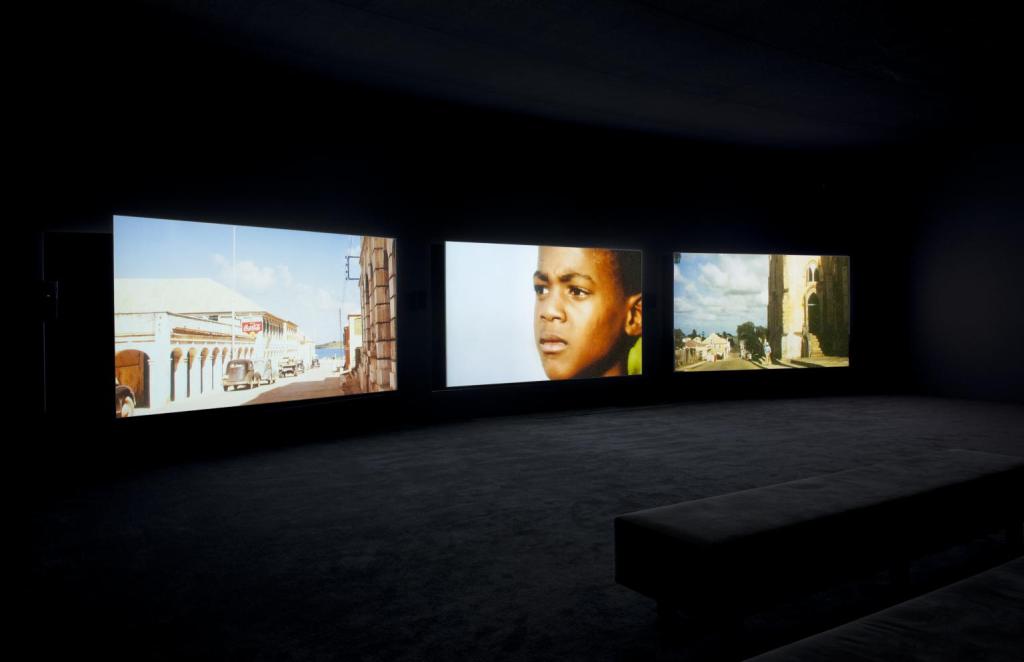
The Unfinished Conversation, 2012

The Unfinished Conversation 2012 is a three-screen video installation that explores the multi-layered and ever-evolving subject of identity through an exploration of the memories and archives of the acclaimed British cultural theorist and sociologist Stuart Hall (1932–2014). The film is narrated in a non-linear format and unfolds over three screens, bringing up a variety of disparate footage simultaneously. This process examines the nature of the visual as triggered across an individual’s memory. Extracted images from news footage of the 1960s, alongside Hall’s personal home videos and photographs, are presented to merge the past, present and future.

Akomfrah weaves issues of cultural identity into the film using a wide range of reference, overlaying archive footage of Hall with a soundtrack made up of jazz and gospel music and readings from a wide range of authors, including William Blake, Charles Dickens, Virginia Woolf and Mervyn Peake. The title of the work refers to Hall’s exposition of identity. According to Hall, identity is not an essence or being, but instead a becoming that is part of an ‘ever-unfinished conversation’. The exploration of Hall’s memory is used with a variety of images intermingling with poetic soundscapes. https://www.tate.org.uk/art/artworks/akomfrah-the-unfinished-conversation-t14105

The six-channel video installation addresses climate change, human communities and the wilderness.

The installation immerses the viewer in the colour purple, a hybrid hue that combines the coldness of blue and the warmth of red, thus symbolizing the complexity and interdependence of every living thing. The montage of scenes of natural beauty creates a painful sense of the looming loss that humanity is facing. The reference to Tyrian purple, an expensive pigment which was initially created from a rare type of gastropod and became a symbol of might for Roman and Byzantine emperors, is a reminder of an early example of humankind’s exploitation of nature not for survival but as a means of acquiring wealth and demonstrating power.

Moving from images of birth to images of death, the narrative unambiguously points to the destructive nature of our activities on the planet, which is inevitably moving toward an ecological disaster.

In his panoramic views of nature’s most stunning landscapes, now altered by humanity, Akomfrah uses a technique popular in Romantic painting, placing solitary human figures at the center of his compositions. But if in German Romantic painter Caspar David Friedrich’s work anonymous figures confront the merciless and sublime forces of nature, in Akomfrah’s video they seem to embody the arrogance reflected in our vision of humankind as the center of the universe, ruling over all life on the planet. The irritating idleness of the figures in Purple reads as a premonition of the global consequences of humanity’s indifference toward its own ecological impact on the planet.  https://garagemca.org/en/exhibition/john-akomfrah-purple

DOUGLAS GORDON

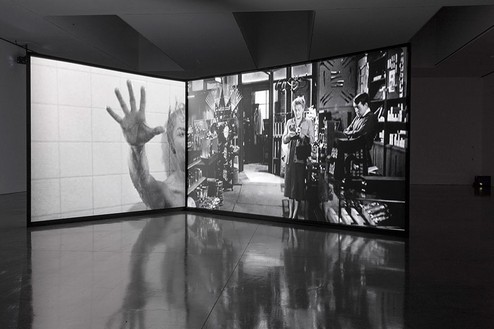
Exploration of expanded cinema. I’m interested in his methods of projections. He likes to explore different and interesting ways of displaying film, and I’m especially interested in his projections and video installations. He also likes to work with multiple videos within a piece. He exhibits videos together, and how they corresponds to each other within a space.

Working across mediums and disciplines, Douglas Gordon investigates moral and ethical questions, mental and physical states, as well as collective memory and self hood. Using literature, folklore, and iconic Hollywood films in addition to his own footage, drawings, and writings, he distorts time and language in order to disorient and challenge.

Douglas Gordon is a contemporary Scottish artist known for his ability to disrupt preconceived ideas about reality. Through his performances, installations, photography, and video art, Gordon readjusts scenes, tinkers with time, and appropriates cultural sources. His video projection 24 Hour Psycho (1993) decelerates the Hitchcock classic, prolonging its viewing for a day. For his sound installation, Something Between My Mouth and Your Ear (1994), Gordon played 30 songs that were popular during the months before his birth in a blue room. The artist has said of his practice that “the drive for me has always been to just push it a little bit more.”

For both films in “back and forth and forth and back,” Gordon has diffused the suspense and longing of their original plots, forming new conditions for viewing and absorbing their content. The film plays on two adjoining screens: on one, the film starts from the beginning, and on the other it starts from the end, so that for an unbearably brief moment (one twenty-fourth of a second), after waiting for twelve hours, the screens show the same sequence, the mirrored images resembling a giant, slow-moving Rorschach test.

A Divided Self I and A Divided Self II (1996)

A Divided Self I and A Divided Self II 1996 is a two-channel video installation displayed on two monitors. The work shows a close-up of two arms, one hairy and the other smooth, fighting each other on a bed sheet. In the first video the hairy arm has dominance, while in the second it is the smooth arm that defeats its opponent. As the videos develop it becomes clear that both arms belong to the artist, and that he is wrestling with himself. As the title indicates, the battle between the two arms suggests an internal battle between two halves of the self; however the source of the self-inflicted torment remains a mystery.

Inscribed within this tradition, A Divided Self I and A Divided Self II takes its title from the Scottish psychiatrist R.D. Laing’s pivotal and controversial treatise on mental illness, The Divided Self: An Existential Study in Sanity and Madness of 1960. In this book Laing argued that psychosis is not a medical condition but an outcome of the ‘divided self’ or the tension between the two personas within us: one our authentic, private identity, and the other the false, sane self that we present to the world.

Gordon often uses his own body as a ground for debate, exploring how contradictory human nature can be, and involves the viewer in the role of both confessor and witness to his investigations. For example, during the late 1990s, following the release of A Divided Self I and A Divided Self II, Gordon made a series of single and double screen videos, including Hand and Foot (Right) and Hand and Foot (Left) 1995–6, Left Dead 1998, Dead Right 1998 and Blue 1998, featuring parts of his body doing something or having something done to them. This series of videos displays a fascination with doubling, mirroring and reflection and portrays the artist turning against himself – wrestling, constraining and disfiguring his own body.


BRUCE NAUMAN

I am highly interested in Nauman’s work because it inspires my work for this project. Particularly looking at his videography and films, he has continued to work with perspectives. He explores perspectives and how the audience will respond to the perspective that we are presented with, challenging the viewer. For example, In Going Around the Corner Piece (1970) is an installation that challenged the viewer in motion.

Bruce Nauman (born December 6, 1941) is an American artist. His practice spans a broad range of media including sculpture, photography, neon, video, drawing, printmaking, and performance. 

Nauman began working in film with Robert Nelson and William Allen while teaching at the San Francisco Art Institute. He produced his first videotapes in 1968, describing the transition from film to video thus: “With the films I would work over an idea until there was something that I wanted to do, then I would rent the equipment for a day or two. So I was more likely to have a specific idea of what I wanted to do. With the videotapes, I had the equipment in the studio for almost a year; I could make test tapes and look at them, watch myself on the monitor or have somebody else there to help. Lots of times I would do a whole performance or tape a whole hour and then change it. I don’t think I would ever edit but I would redo the whole thing if I didn’t like it.” Using his body to explore the limits of everday situations, Nauman explored video as a theatrical stage and a surveillance device within an installation context, influenced by the experimental work of Merce Cunningham, Meredith Monk, La Monte Young, Steve Reich, and Phillip Glass. 

Throughout his career, Nauman has returned to the kind of performance art in which the performer suffers. The video installation Clown Torture (1987), one of his few truly emblematic works, gives us a costumed and face-painted figure being forced to repeat a series of phrases and actions to the point when physical pain sets in. Sometimes, we’re the ones made to suffer: Learned Helplessness in Rats (Rock and Roll Drummer) (1988), an installation featuring concurrently playing videos of a rat in a plexiglass maze and an amateur rock drummer joylessly hammering out a beat, is something of an endurance test. The crazed, repetitious drumming echoes through PS1’s galleries, inducing a pronounced sensation of anxiety. 

Employing a tremendous range of materials and working methods, he reveals how mutable experiences of time, space, movement, and language provide an unstable foundation for understanding our place in the world. For Nauman, both making and looking at art involve “doing things that you don’t particularly want to do, putting yourself in unfamiliar situations, following resistances to find out why you’re resisting.” At a time when the notion of truth feels increasingly under attack, his work compels viewers to relinquish the safety of the familiar, keeping us alert, ever vigilant, and wary of being seduced by easy answers.


EXPERIMENTAL FILMS

This is a collection of experimental films that I have researched and been inspired by. Hopefully by looking at some of these films and artists, I can adapt and attempt some of the experimental techniques that are used, as well as try by own experimentation.

Two Sides to Every Story 1974, Michael Snow
Each side showed a perspective of two opposite camera men where they were filming a woman walking and moving between them.
This is very similar to my plans, technical-wise, for having a projection on different sides of the same screen.
SSHTOORRTY 2005, Michael Snow
The film of the above-described scene was cut exactly in half and the two halves of sound and picture as super-imposed. This makes a simultaneity of actions that occurred ‘linearly’. Before and After become a Transparent Now Arrival and Departure are united. It’s truly ‘filmic’, one transparent film over another.
It’s a ‘painting’ about a painting. I was very concerned with the mobile color mixing that would eventually happen. Colors were carefully chosen as I tried to predict how they would mix and interact. I make ‘pictures’ and the experience of looking at them is more important than the ‘elsewhereness’ of a story, even in this, my most ‘story-telling’ film. In that respect, part of the perception or ‘reading’ of the film involves one’s choices of what went before and what came after in the actual pre-filmic event.

I really like the overlapping of the footage in this film. Not only did Snow overlap the footage of scenes of two different conversations, but he also extended that to the texts, overlapping ‘short’ and ‘story’ together to create SSHTOORRTY.
Infinity Kisses – The Movie 2008, Carolee Schneemann
Infinity Kisses – The Movie completes Schneemann’s exploration of human and feline sensual communication. It incorporates extracts of the original 124 self-shot 35mm color slide photo sequence, Infinity Kisses, in which the expressive self-determination of the ardent cat was recorded over an eight-year period. Infinity Kisses – The Movie recomposes these images into a video, in which each dissolving frame is split between its full image and a hugely enlarged detail.
I actually don’t really like this film as much. However, I specifically like how the footage is cut down permanently on the same line to the right. It incorporates the film shots slide sequence, but i like how it gives a sense of separation between the two images.
Mankinda 1957, Stan VanDerBeek
There’s this scene in this film where a face of a man is drawn and erased and drawn over again and again with white pen on a black board (at around 3:55). Maybe I can use this as found footage in my work.
Film Form #1 1968, Stan VanDerBeek
I like the heavily-edited colouring of the film. Has a lot of abstraction elements to it, including the incomprehensible scenes/shots of patterns, bright colours, fades, graphics. I also like the use of the fish-eye angle (180 degree lens) shooting the human body from above, which displays the body small.
Raumsehen und Raumhoren 1974, Valie Export
Like in ‘Split Reality’, the personality conveyed by a medium in this performance tape appears to be schizophrenic. Two video cameras and a mixer make possible a closed-circuit action that demonstrates not only the differences in the way the viewers perceive a person who is physically present in the room and simultaneously electronically reproduced, but also how the image is manipulated by its electronic conveyance. The camera zooms in and out, subjecting the performer’s monitor likeness to permanent alteration. Specific synthetic sounds are linked to the picture: optically close = loud sound and rapid tone repetition, optically remote = quiet sound and slow tone repetition. The work is arranged in 6 parts: 1. space position, 2. split images, 3. space position composition, 4. split image composition, 5. body, 6. body composition.
I like the different experimentation that are carried out in this film. It works with different angles of the human body in a space.