Feedback review
5:32 (2020) Project
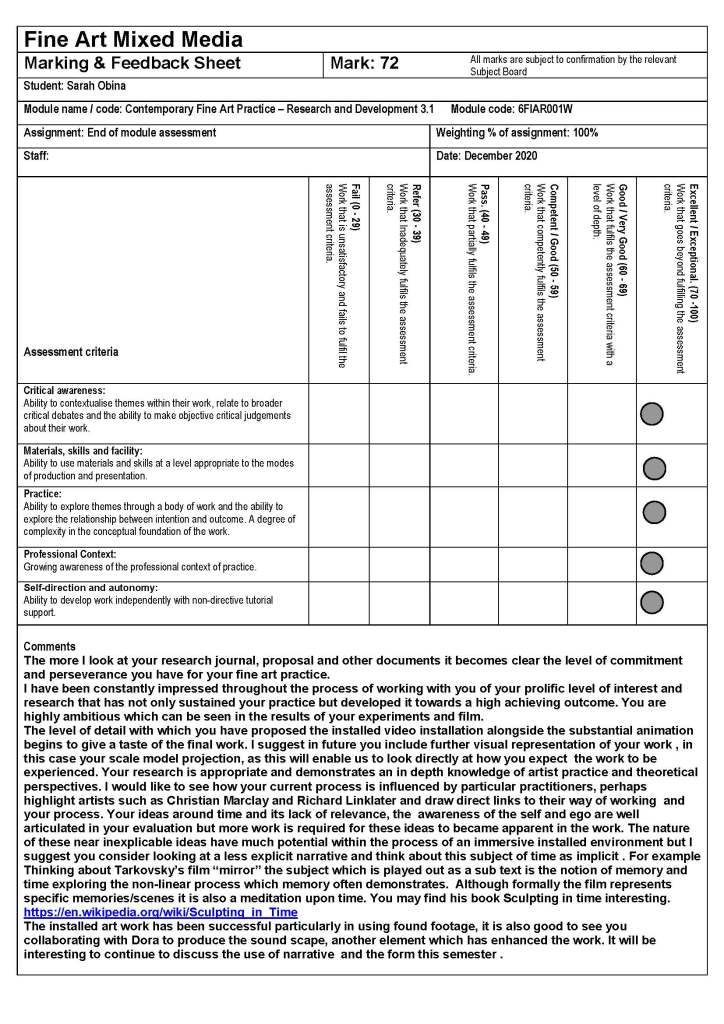
Andrie Tarkovsky Book – ‘Sculpting in Time’ https://en.wikipedia.org/wiki/Sculpting_in_Time
Andrie Tarkovsky Film – ‘Mirror’ (1975)
CTEQ Annotation on Film – ‘Mirror’ by Sam Ishii-Gonzales (2014) https://www.sensesofcinema.com/2014/cteq/mirror/#8
- the film that most succinctly recapitulates the filmmaker’s aesthetic: his belief that cinema is, first and foremost, a medium of time, a medium that allows both artist and viewer to come to terms with the force of time and its role in the constitution of subjectivity
- But rather than remain focused on one time frame, he decided to create a narrative that moves backwards and forwards in time, so as to chronicle one man’s life through the 20th century, a life lived not solely in the present but in some complex temporal zone between past and present, one where the past remains present to us, where the past is not past
- the idea of juxtaposing his memories with someone else’s memories, except now this idea is expressed through the use of archival footage, which is to say objective memories rather than subjective ones, memories that have been left behind as traces or deposits on strips of celluloid
- freely moves between time frames, between fictional recreations and archival footage, between colour and black-and-white film stocks, and this might produce, on initial encounter, a degree of confusion on the viewer’s part
- telling a story through the medium of film, through the use of images suffused with movement, time and light
- This is what distinguishes cinema from other artistic forms: its ability to record a moment of time and repeat it; to make the past present in (or as) an image. As Tarkovsky says, “No other art can compare with cinema in the force, precision and starkness with which it conveys awareness of facts and aesthetic structures existing and changing within time”. Cinema testifies, in other words, not only to the persistence of time but its permanent status as a medium of change or transformation.
- the time that Tarkovsky is speaking about is not personal or subjective. The filmmaker doesn’t create time but works with the time they are given – a time internal to the image itself.
- key point for Tarkovsky because it ensures that the inward turn necessary for the creation of an original work of art is met by a complementary outward turn that reconnects the artist to the world – allow the viewer to experience the heterogeneous force of time, a time that isn’t simply internal to the work but is also felt by the viewer as part of their experience of seeing the film
- Tarkovsky is led to proclaim that the main reason we are drawn to the cinema is for the experience of time:
I think that what a person normally goes to the cinema for is time… He goes there for living experience; for cinema, like no other art, widens, enhances and concentrates a person’s experience – and not only enhances it but makes it longer, significantly longer. That is the power of cinema.
– Tarkovsky
Mirror Essay by Michael Pattison http://www.tarkovsky.co.uk/mirror-essay
- structured as a dreamlike mood poem, progressing by means of associative leaps rather than a strict cause and effect logic. It helps to unshackle the images, affording them a freedom to work as standalone compositions
- magic of memories was that they’re always half-fabricated, distorted, allowed to blur into one another
- We are guided through this by a masterfully imaginative, rhythmically precise soundscape, in which voiceover utterances of “Papa” and “Mama” act like punctuation marks that glue the emotional meaning of the work together. Likewise, we must adjust to the inexplicable switches between sepia and colour
- some of the images in Mirror are all the more beautiful for being so fleeting. And while many of them unfold in slow motion
- Maximising their visceral impact, he cuts his slow-motion scenes short at the very moment they jerk to dramatic life ie. when a bird crashes through a window, for instance, or when another takes flight from the hand of a dying man
 Sarah K Obina