The Film
Because I had abandoned the work and direction that my current work was heading, I had decided to begin again and go from the research I had found on the theory of time and artists that I have looked up. I came up with a long list of different time-based experiment that I could possibly think of and explore some of those aspects:
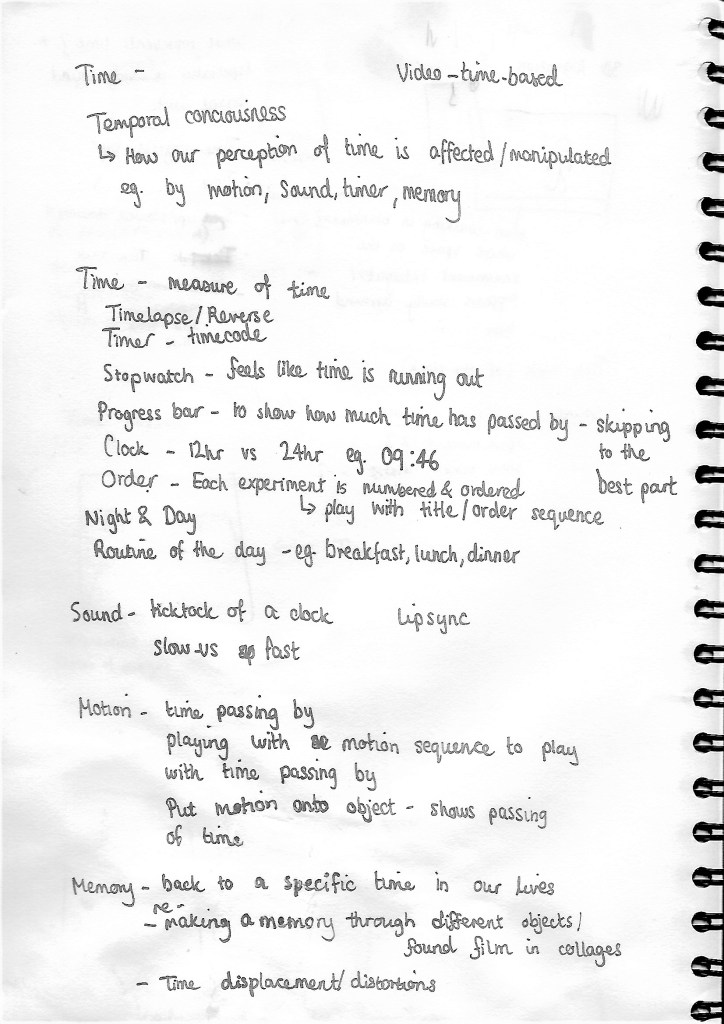
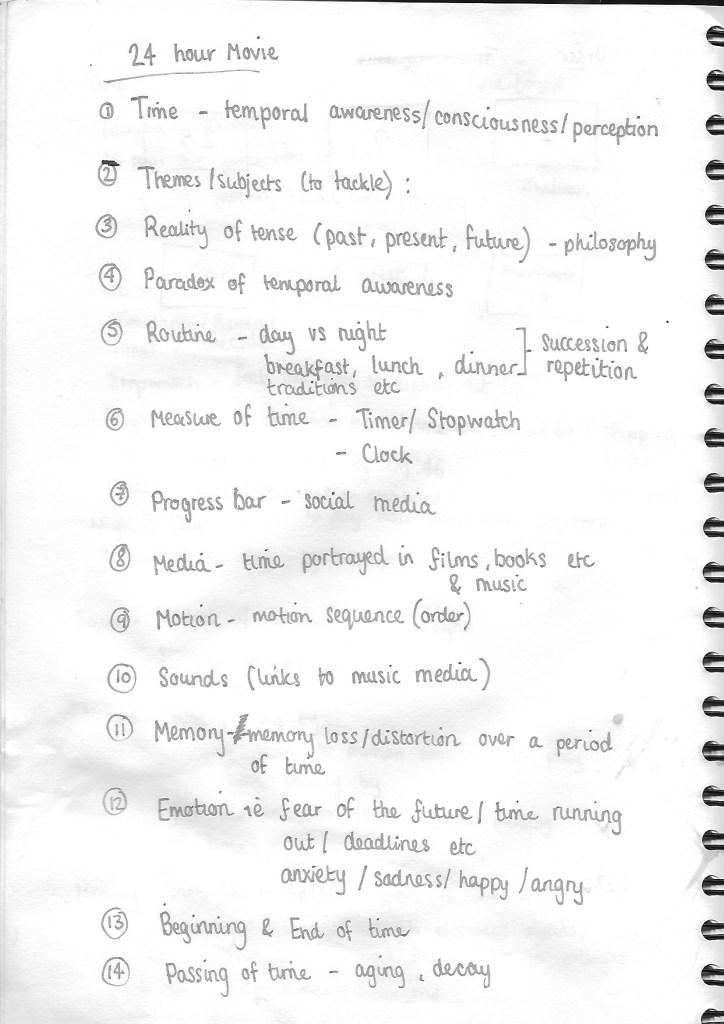
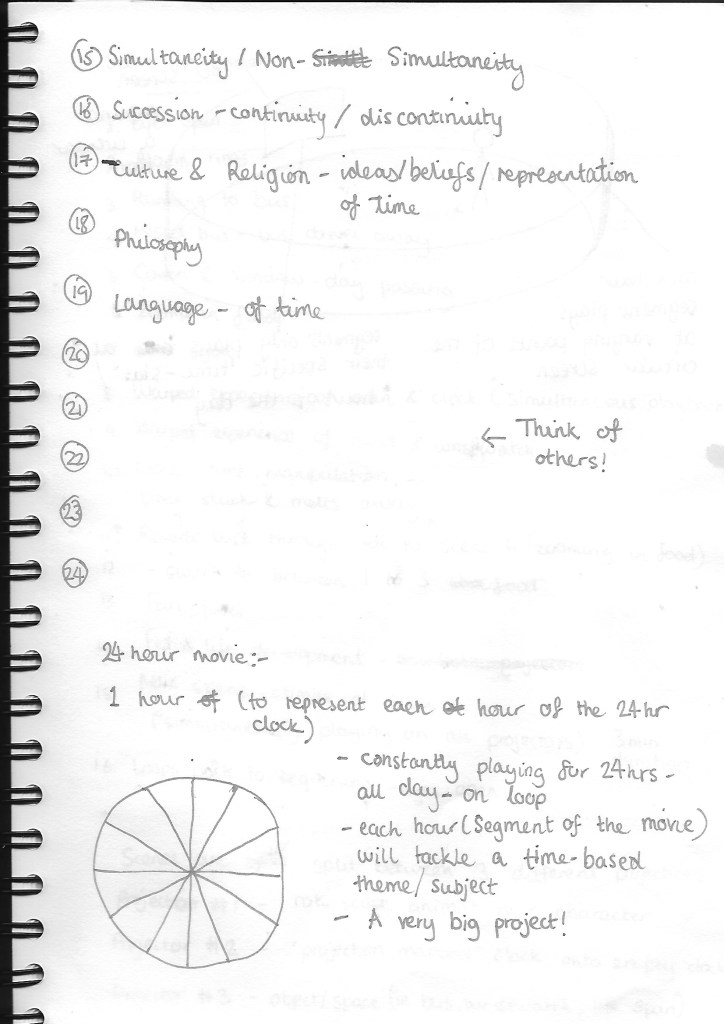
After looking at this list, I came up with the idea of a 24 hour movie. Looking at this idea, I’ve realised that this is a very big project, something I could possibly do for my next project, in extension to my work now.
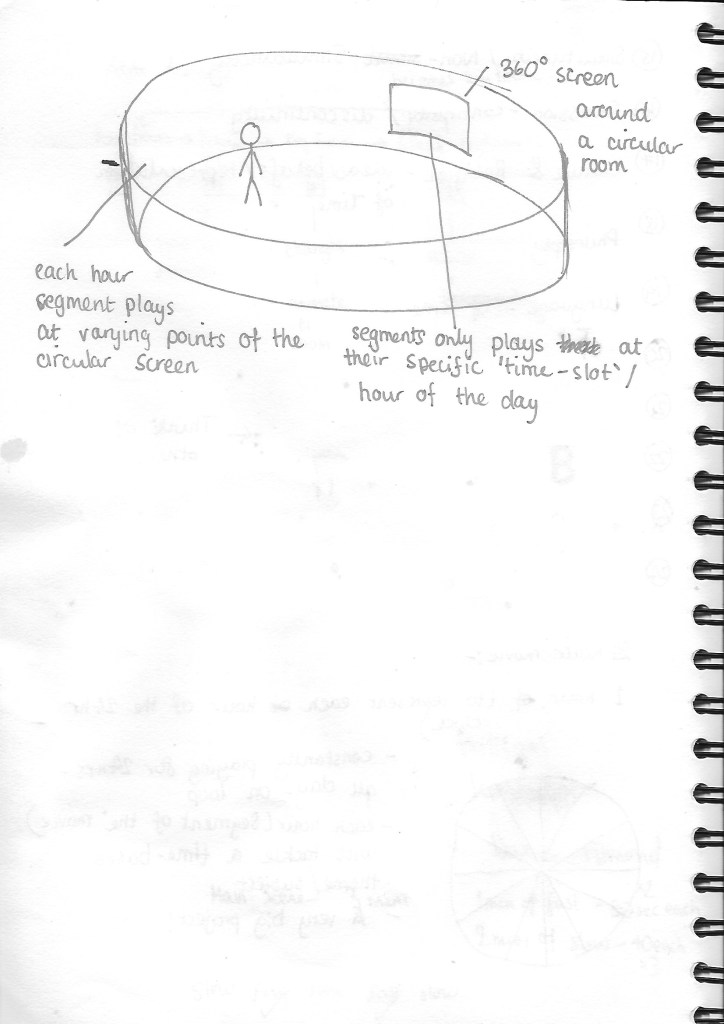
The work will be a 24 hour long film, playing in real time, all day. Each hour of the day will be dedicated to one of the 24 themes/aspects of time and temporal consciousness and will explore them in different ways. I even had this idea that the film will be presented onto a long screen that encircles the viewer in. Each segment of the movie will play after each other in chronological order around the screen.
This is a very ambitious concept that I would like to beginning exploring. For this project, I’ve decided to take a couple of ideas and inspiration from this large project and focus in on a few themes to tackle. I decided to produce a short film instead, complete with a storyline, based around the idea of time perception and manipulation/distortion.
Context & Research
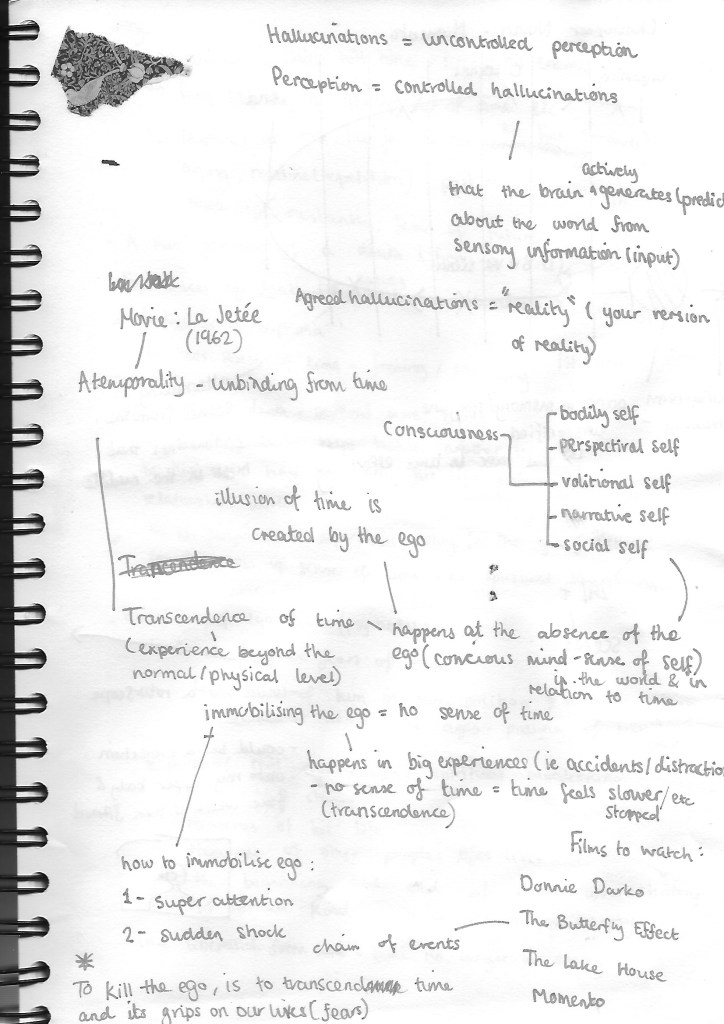
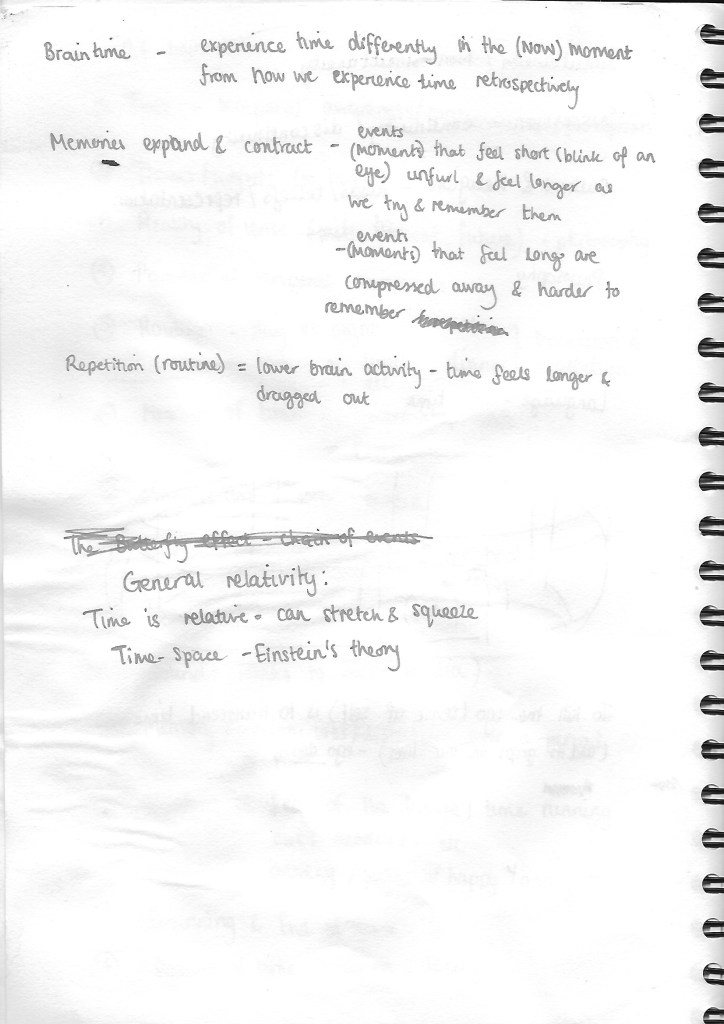
TO KILL THE EGO, IS TO TRANSCEND TIME (and its grips on our lives).
Storyline
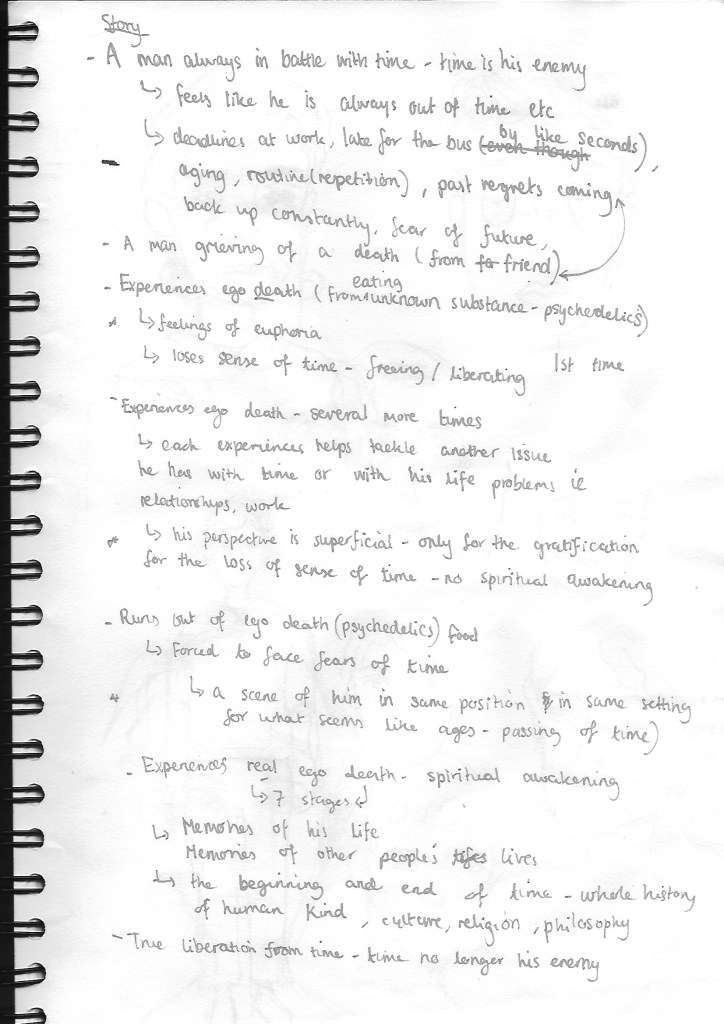
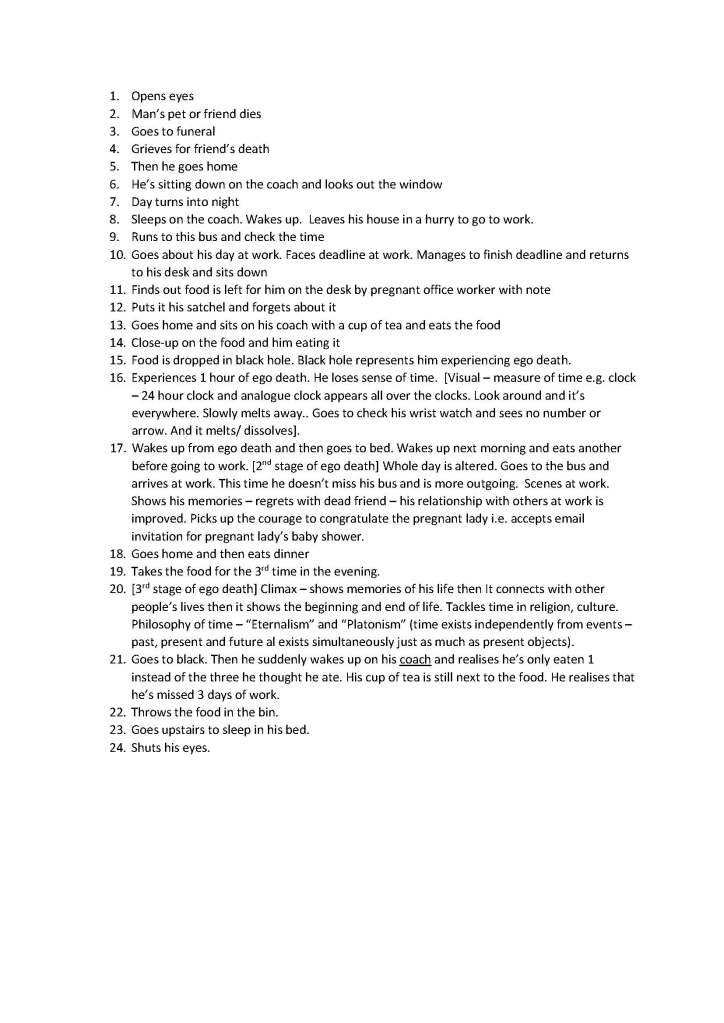
Once again, the storyline is written for a full feature length film and I wanted to refine and condense the plot/scenes to make it more feasible. Also it allowed space for experimentation and creativity, rather than becoming too rigid and sticking completely to the storyline. I wanted the scenes to be more open to interpretation rather than fixed to the plot. After some refining, I came up with this plot, with scenes already in order.
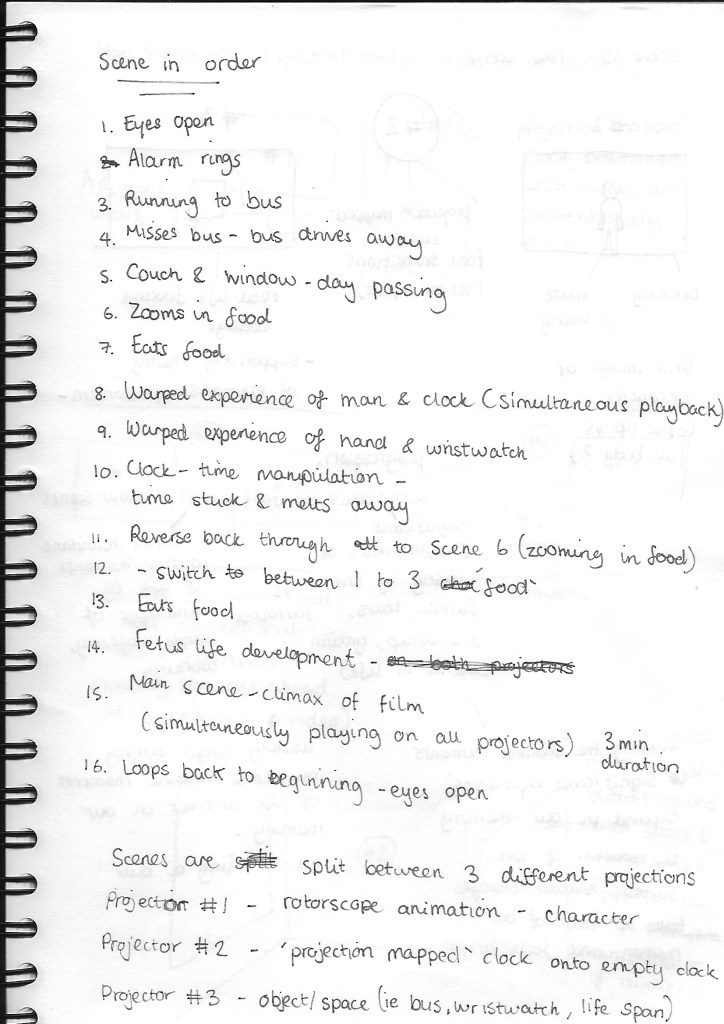
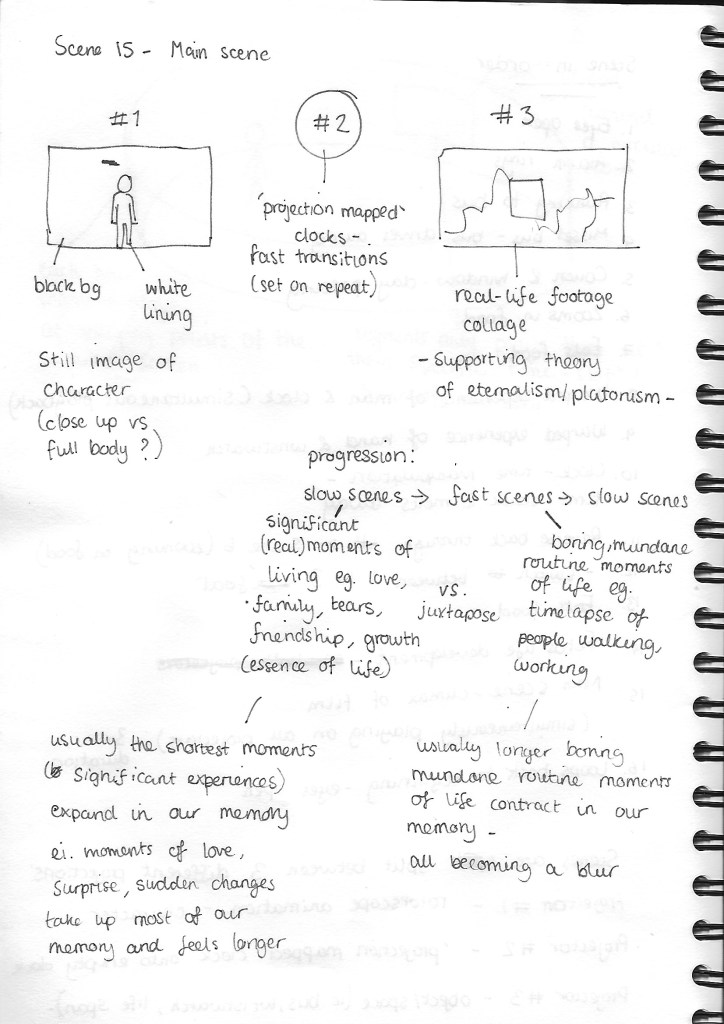
Scenes explained – relation to time perception
- Alarm ringing, missing the bus – reveals the battle of time and the feeling of always running out of time
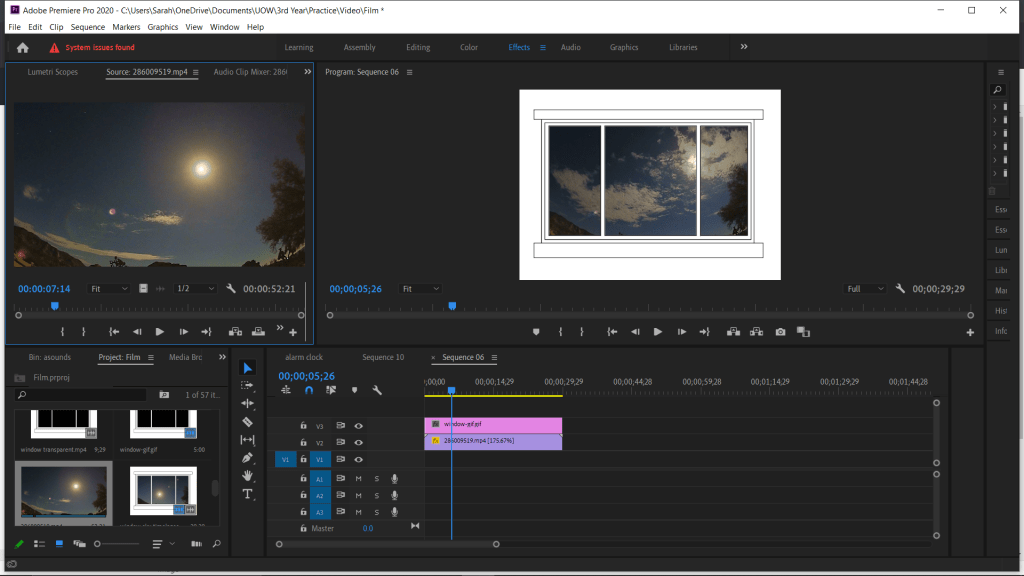
- Window (time-lapse of the day) – shows the passing of time, something we tend to overlook in the busyness of our daily lives.
- Food – (not explicitly revealed in scene) – a representation/experience of something-like of ego death where sense of time is lost
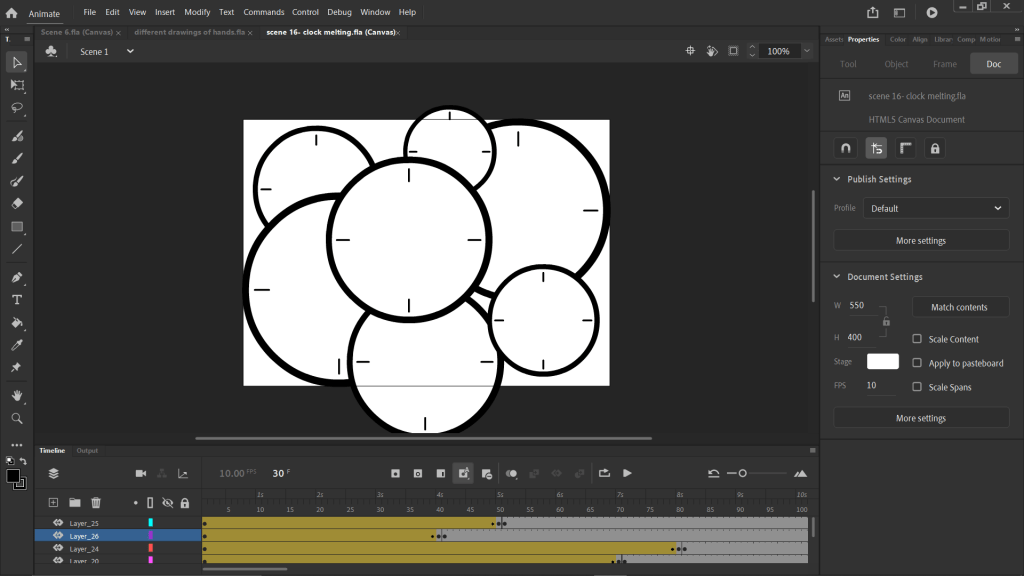
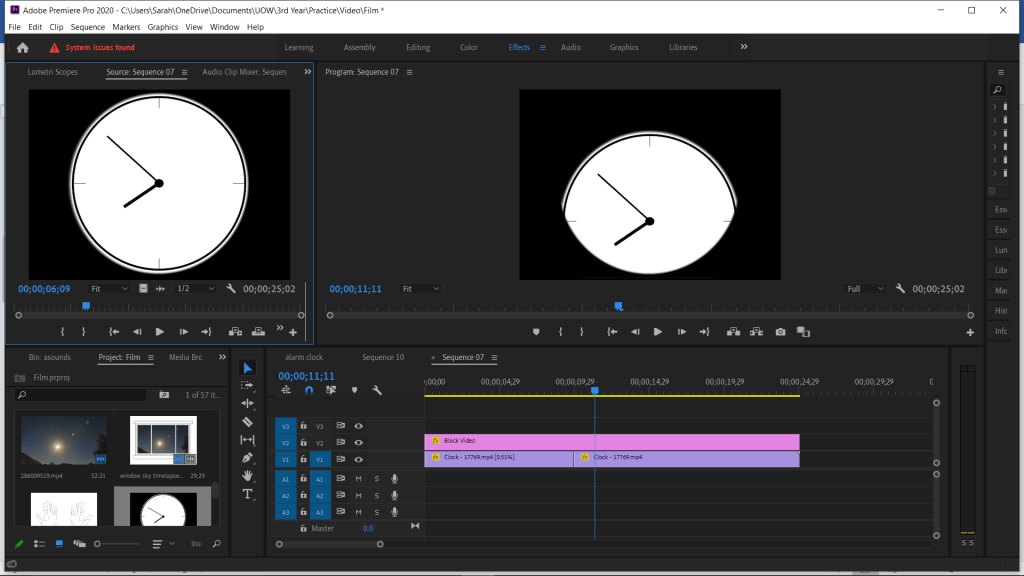
- Clock distortion – lose sense of time
- Reverse – explores short-term memory, routine, history
- Life development – lifespan
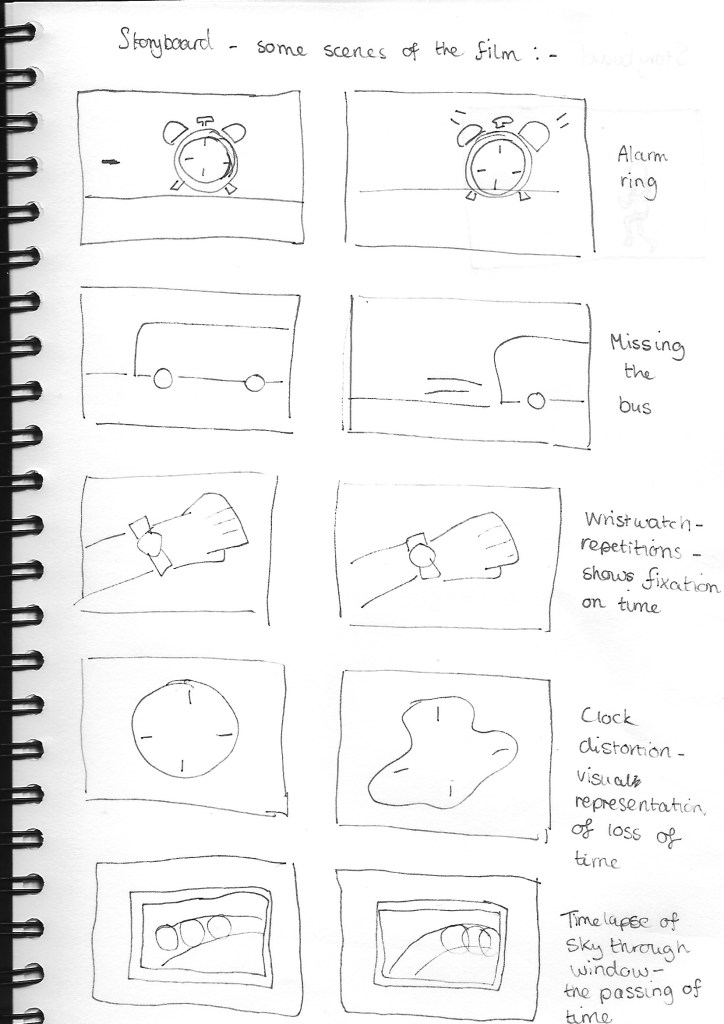
Storyboard
Drawings of how I visualised certain scenes:
The Process
Rotoscope Animation
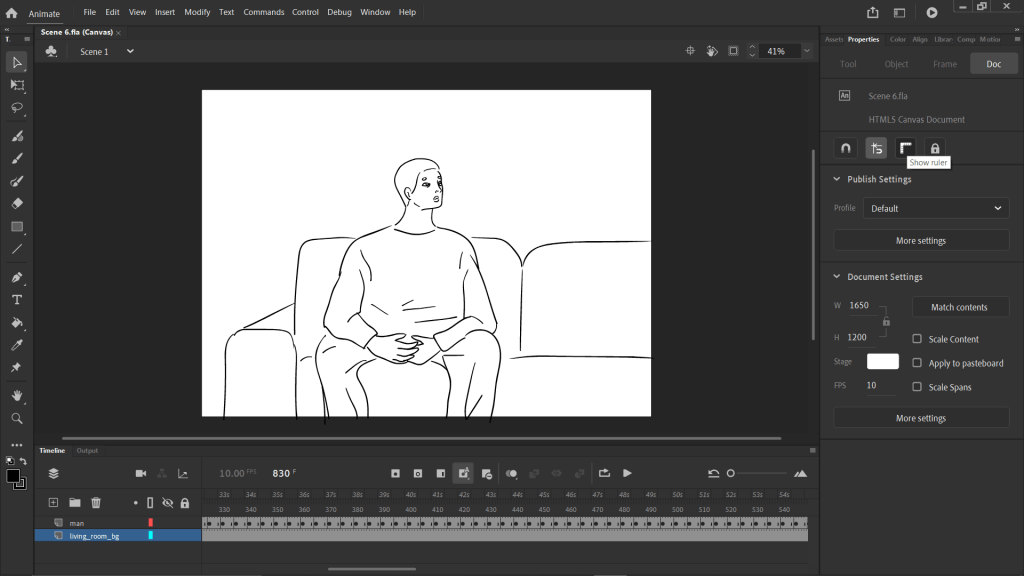
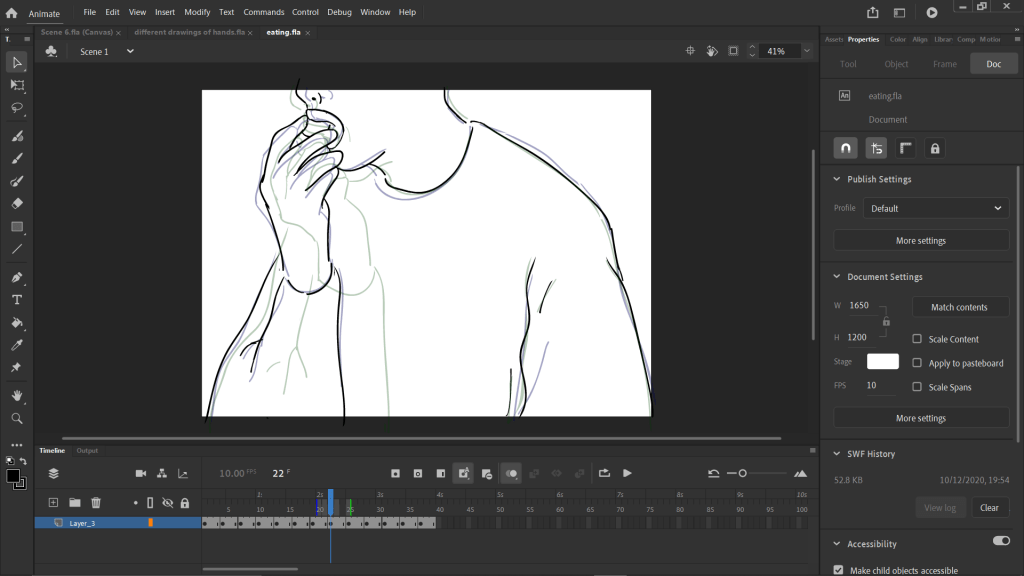
Adobe Animate CC
- Dimensions: 1650 x 1200 Full HD Actionscript3.0 or HTLM5 Canvas
- Standard is 30fps – I lowered it to 10fps to lessen the workload
- Frame-by-frame animation
- Use of onion skins
- Motion tween
This is the first time I’m using the software Adobe Animate for my project. I had to learn how to use the interface. I used my laptop, and borrowed a WACOM drawing tablet from the media store at university.
I decided to produce a rotoscope animation as it would be easier than producing a real-life film in the midst of a pandemic. I also like learning new skills and I find that in rotoscope animation, since I am the drawer, I have freedom to be creative and reproduce the scenes of the film from my mind, digitally.
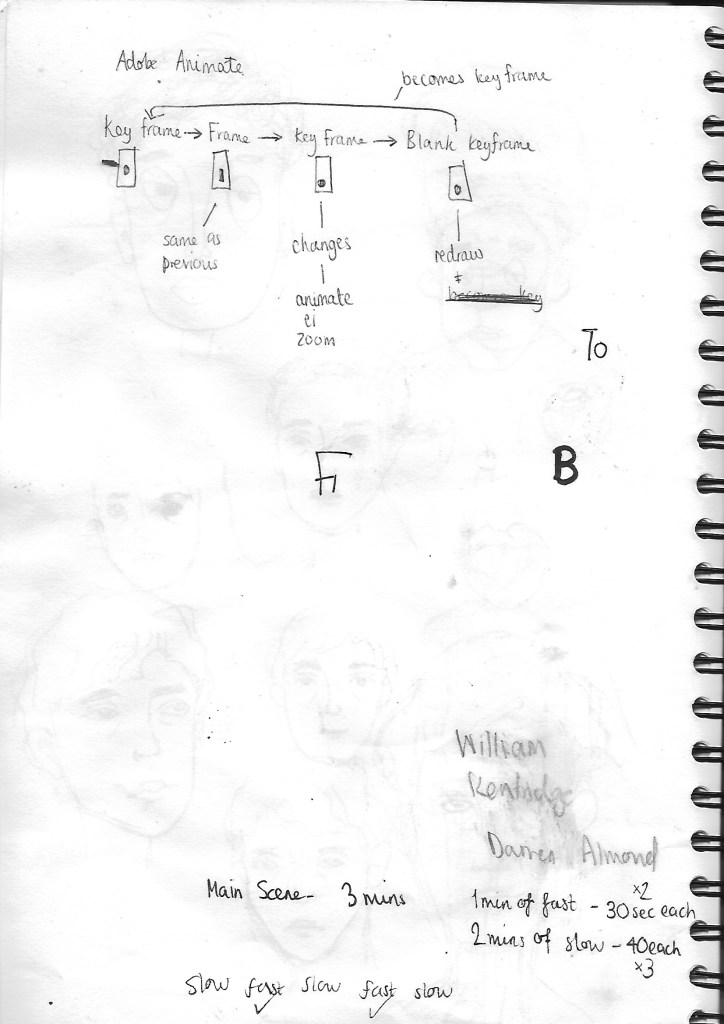
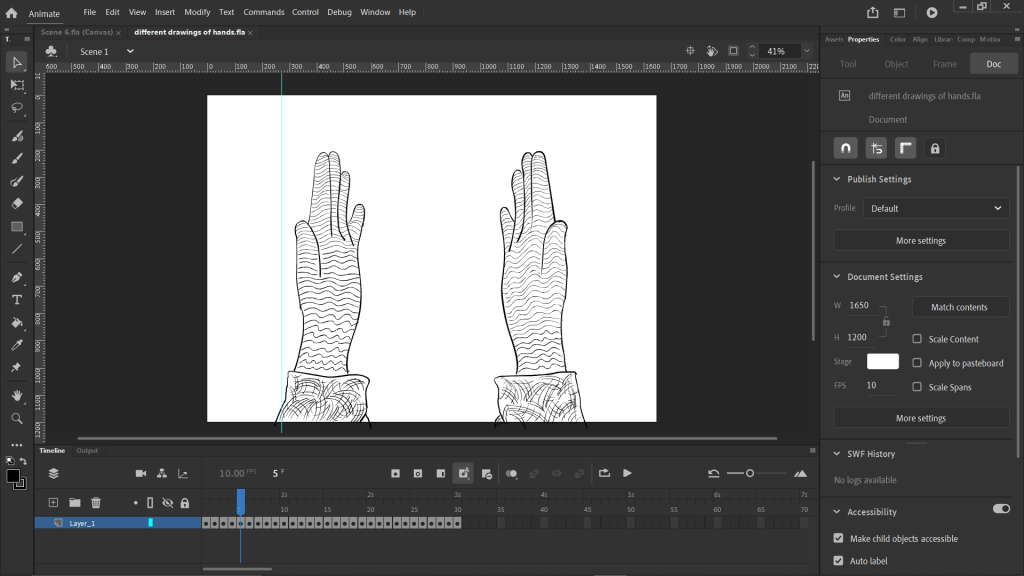
Furthermore, I think the media relates quite well to my work, because rotoscope animation is time-consuming and tedious. It involves a lot of repeated action of drawing out the same character, helps me understand better the idea of motion sequence. To produce a second of footage would consist of 10 frames, meaning 10 drawings which probably takes me 20 minutes.
Here is the first trial scene that I drew out.
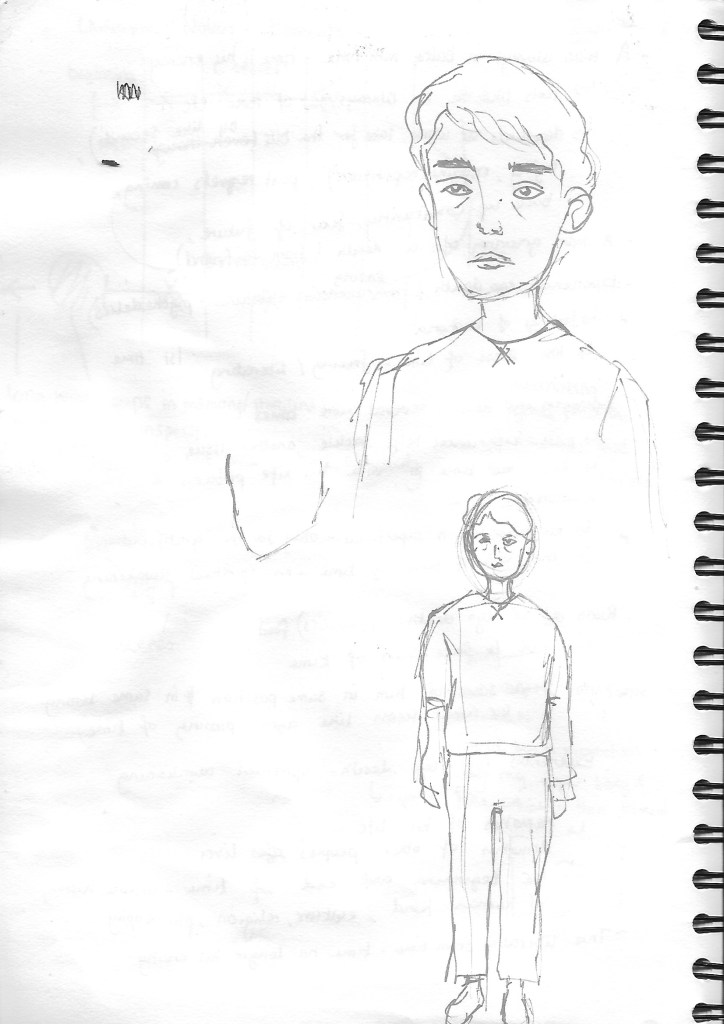
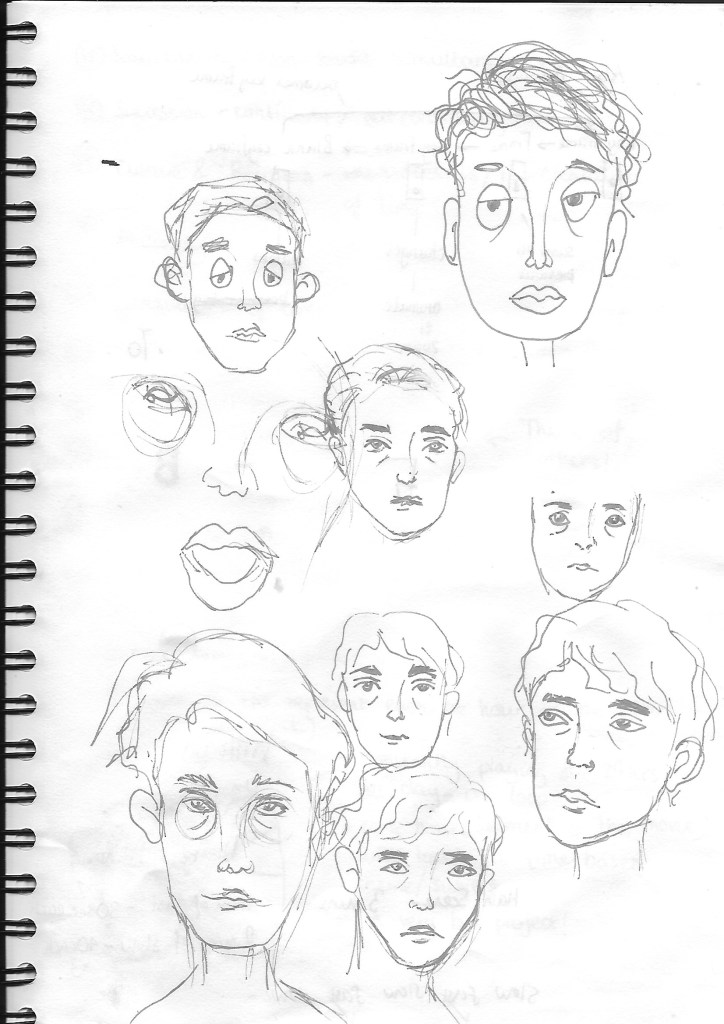
Character development
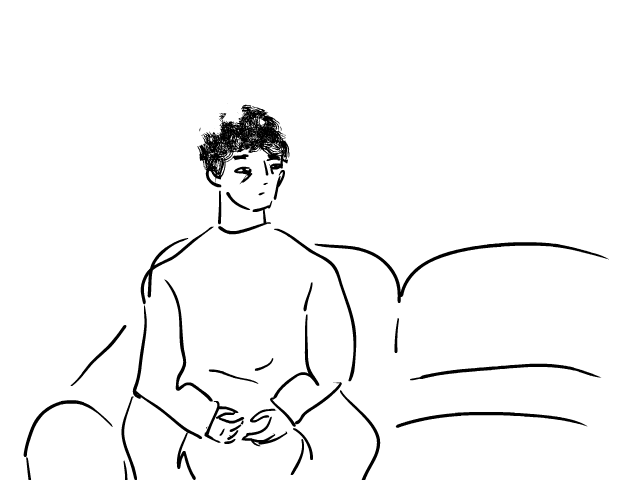
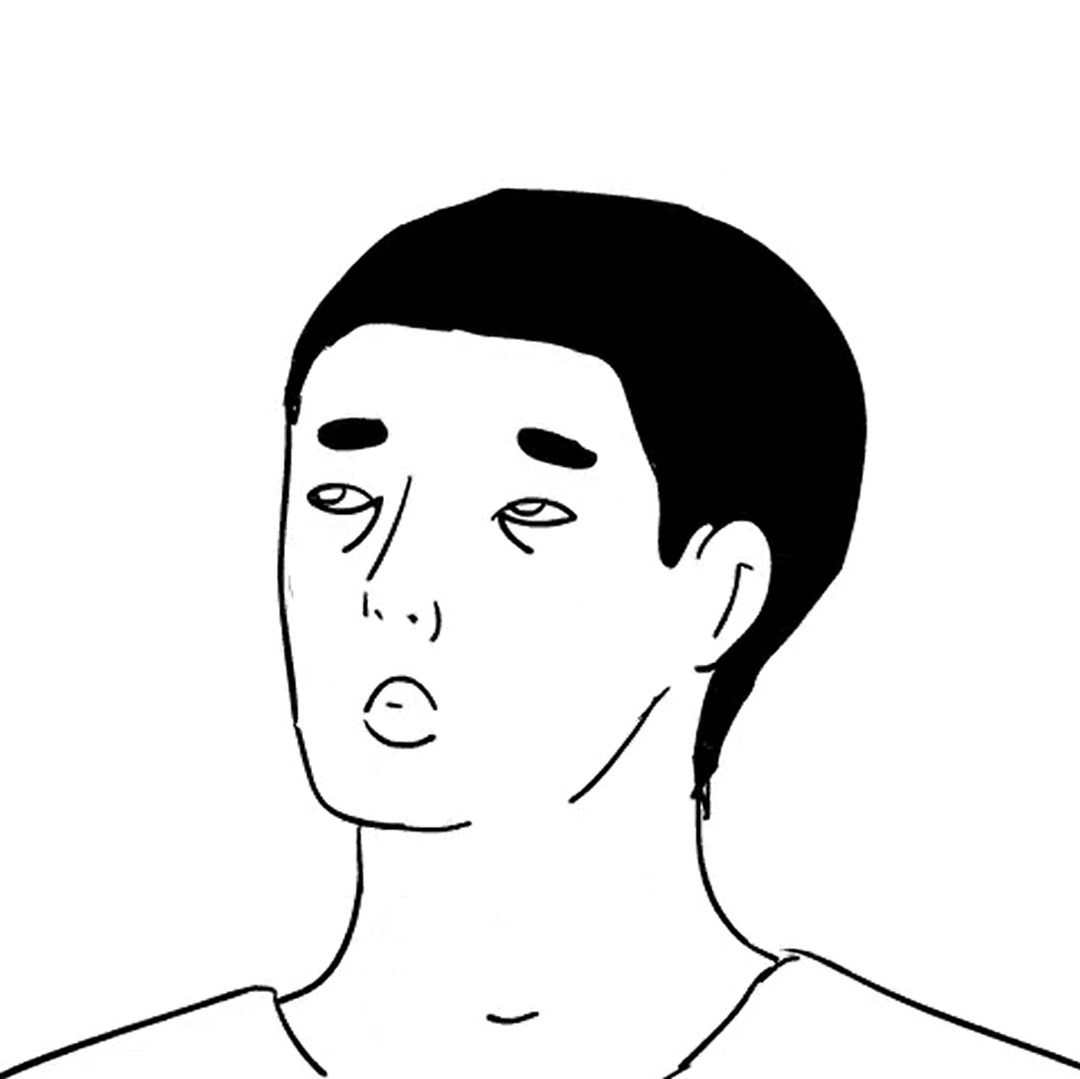
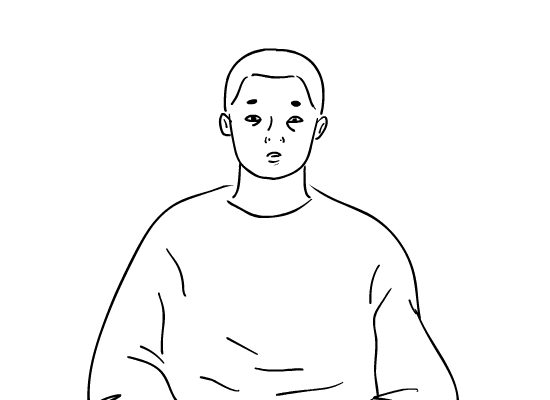
I wanted to design a character that appears to have been beaten down by life and time, thus the dark eyes bags and dishevelled hair (unkept because he has no time considering that he’s always running late etc).
Unfortunately, working on Adobe Animate, certain brush settings that was used for the messy hair look, slowed down the system heavily.
In the end, I decided to go with a simple character look with short buzzcut hair and eyebags. Not only is this easier & quicker to draw, which make the rotoscoping much more convenient and a faster process, but also portrays like a template of a person in which most people can relate to.
Alterations
In the original storyboard plot that I explained in detail above, there was a bus scene. It was of the character running after the bus and missing it. I had animated the scenes, but in the end, I had decided to remove it as I thought that it did not go well with the plot development, and it broke the flow. Below are the scenes that I removed from the film.
Video
Premiere Pro CC
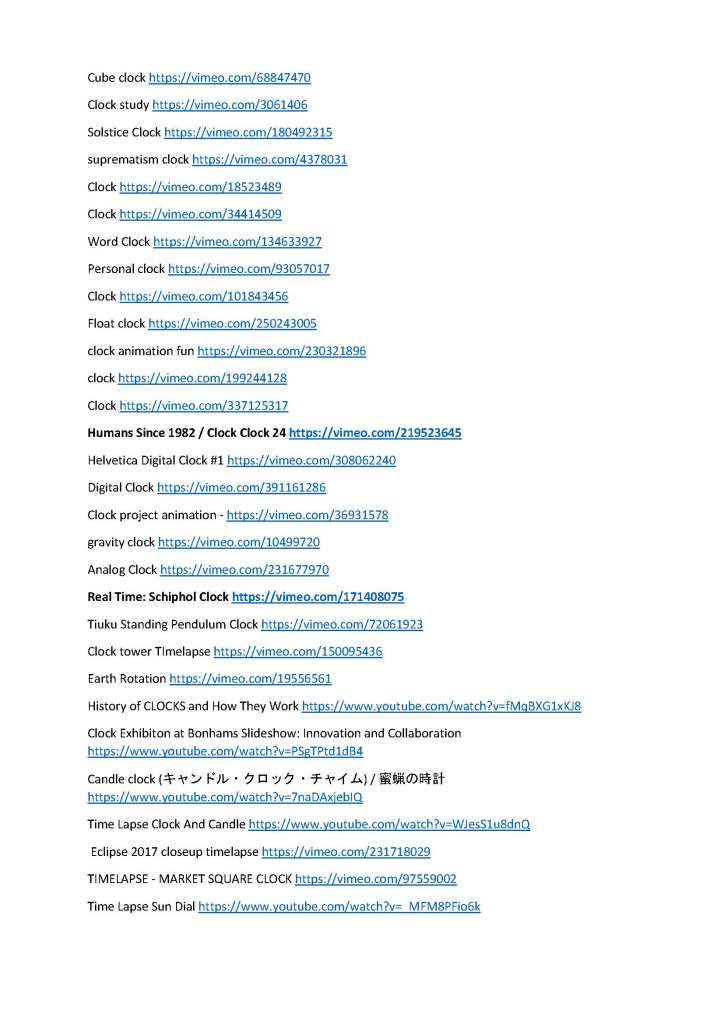
Producing found footage collage
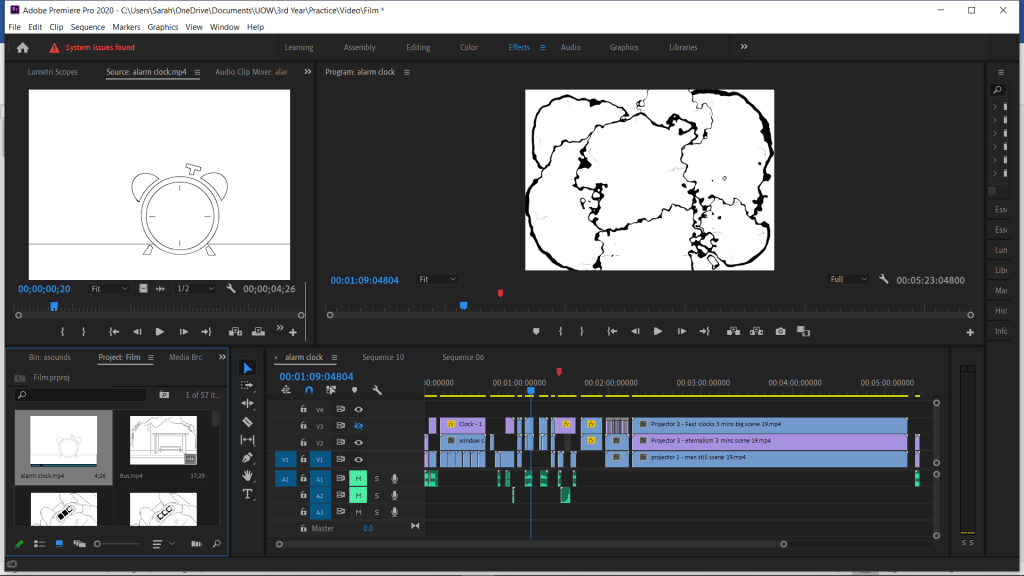
I used Premiere Pro to put all the animated scenes together, including the found footage collages. Each layer represents each projector. I edited it so that all 3 projectors are interacting and engaging with each other, in order of the timeline. I also edited with some effects, i.e. turbulent displacement for the distorted visuals.
Clock – ‘projection mapping’ – to allude to projection mapping, the shape of clock is masked
Sounds
For the film, I decided to have no audible dialogue. Instead, I decided to use my own sounds that I produced on Adobe Audition and Dora’s sounds. Initially, I planned to use 2 sounds from Dora and 1 of my own. However, I ended up using both sounds from Dora Maludi.
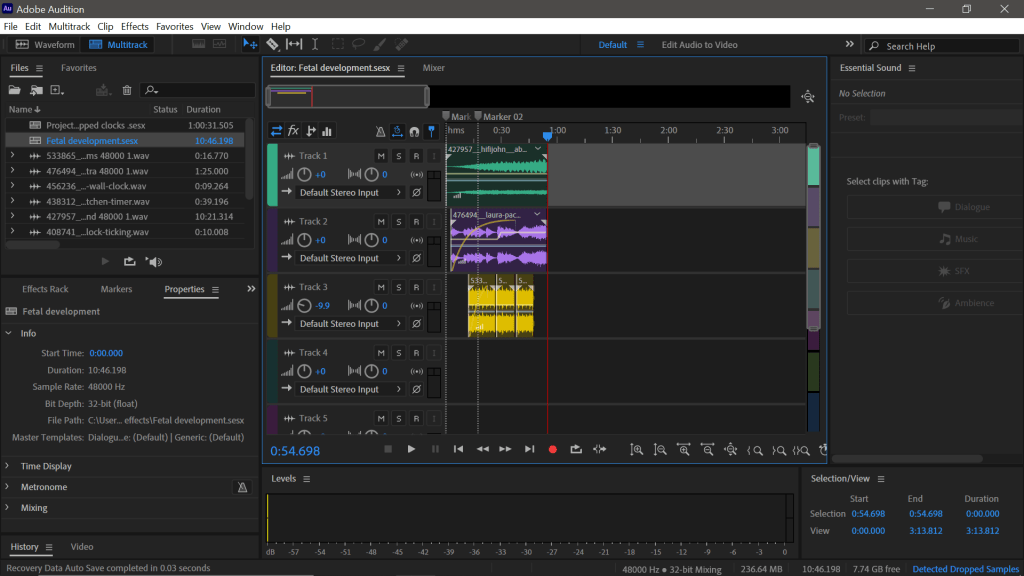
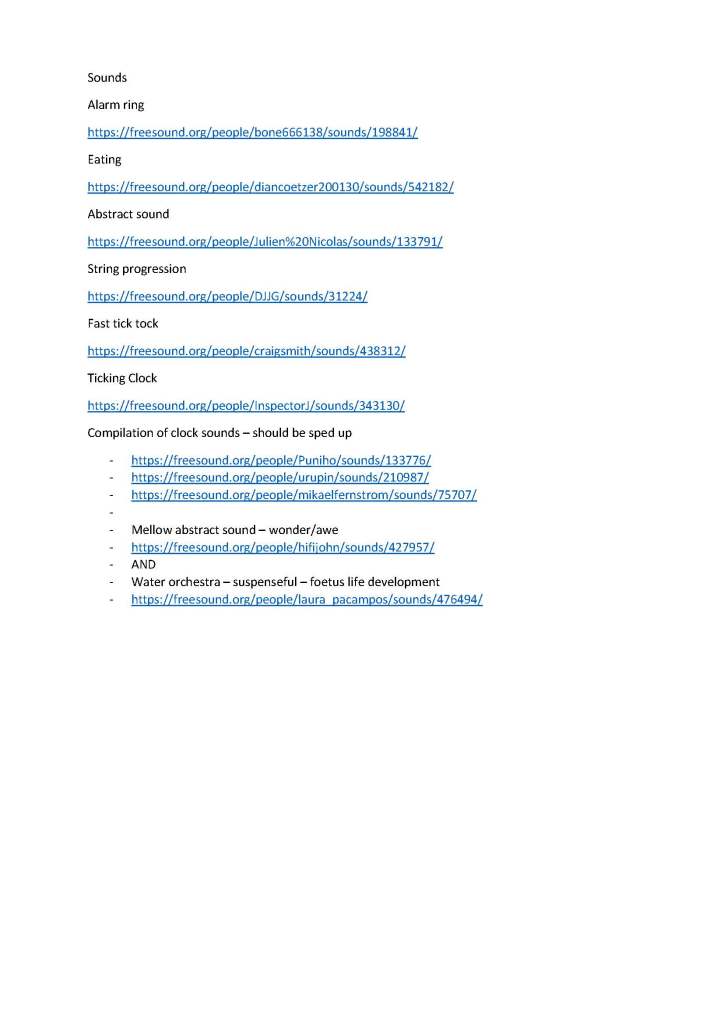
Below, is the sound I made that ultimately was never used for this particular work. The way I produced my sound was by mixing found sounds that I collected from the site, freesounds. I mixed and scored it to the matching video, which is the development stages of the foetus.
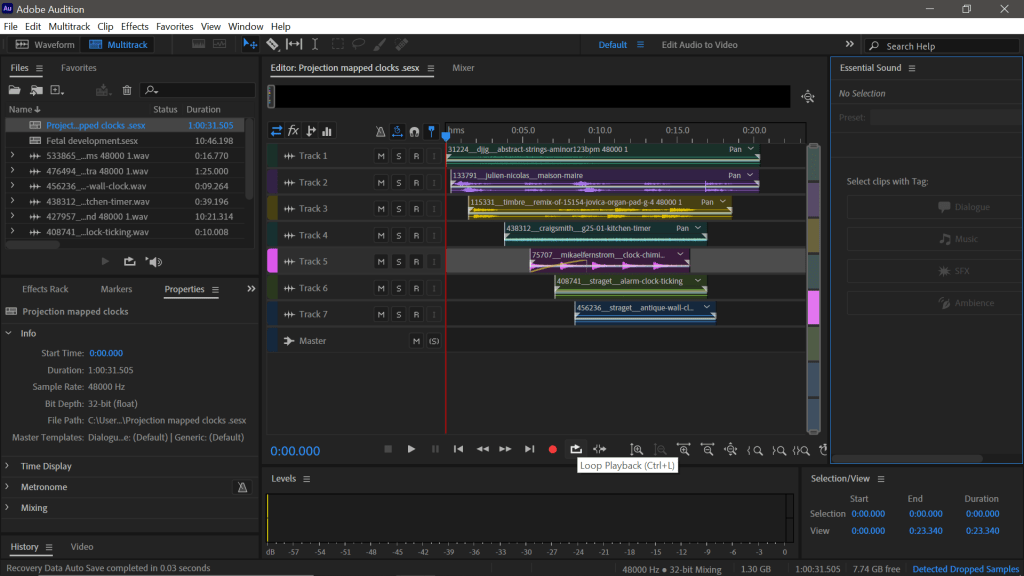
I also produced/mixed another sound based on the sound of clocks. I did this with the idea that it will accompany the video of the collection of clocks. In the end, I decided not to use it. However, it is here to reference my exploration with sounds.
 Sarah K Obina