Artist Research
Note: Personal Commentary are highlighted by texts that are bold and italics
Example: I personally resonate with this artist and the nature of their work, because I am particularly interested in the themes that they explore in their practice.
Gary Hill
Born in 1951- Foundational artist in video-art, based on single-channel work & video/sound based installations of 1970’s/80’s.
” I live through a succession of texture”
” For a moment I live a pulse of another being and it was over”
“There is nothing to leave nothing different exists. Only through sound, a wall of sound, can i go through it”
“Will there be a moment of recognition?”
A single moment of the body is ‘captured’ by the single flash of strobe light- edited and formed into a linear text & sequence of a body in various positions up against the wall.
This work refers to succession and the idea of continuity or discontinuity. The succession is anchored into the physicality of the body ( being ‘captured’).
Quite a simple work yet intriguing and dramatic because of the intense and quick strobe light, especially if seen live as performance.
The experience: feels like time is stopped and started. The focus is on the sight ‘captured’ and the word that comes next in the narrative, which creates an experience of continuity and brief intervals of temporal presence.
Bill Viola
Contemporary video artist born 1951
Viola often bases his works on his Buddhist beliefs, one being that there is not a single reality, but rather a constant flow of illusions. I can see it in this work too, in regards to time. Time is extended and becomes an illusion from the reflections of the pool. He plays with both the stillness of time and time passing, in the same work (the man paused in time in contrast to the pool).
Viola is known to use images of transition – from day to night, motion to stillness, time to timelessness – to explore motion, perception etc.
Janet Cardiff and George Bures Miller
Canadian-based artists in collaboration and partnership.
I like the image of a screen within the screen that is presenting the same setting but at different times. Can see the two different events happening, from the phone and video walk. There is a lot of contradiction between the two screens ie. the presence/absence of people, the events. It is also site- specific.
Refers to memory. The narration refers to past memories, old stories and memorabilia/objects of the past. Metaphors of the past are described as objects ie the closing of the suitcase to forget the past.
This is a really interesting piece of work that I really enjoyed.
“Sound has the ability to transport you through time very easily, so if you give a sense of historical sounds, people are subconsciously taken to that era.” – Janet Cardiff from Fooling Reality: A Conversation with Janet Cardiff and George Bures Miller
Further reading:
- ‘Doing’ memory: performativity and cultural memory in Janet Cardiff and George Bures Miller’s Alter Bahnhof Video Walk https://www.tandfonline.com/doi/full/10.1080/17504902.2019.1578454
- Fooling Reality: A Conversation with Janet Cardiff and George Bures Miller https://sculpturemagazine.art/fooling-reality-a-conversation-with-janet-cardiff-and-george-bures-miller/
Douglas Gordon
Born 1966 in Scotland
Often Gordon will play with the idea of time within video (which is time-based), using repetition, changing duration, multiple monitors etc.
Richard Linklater
- Self-taught writer-director
- Born 1960 in Houston, Texas
A more surrealistic, abstract approach to the meaning of time, space and reality. This work is more interested in philosophy.
The way the film is edited, using rotor scope animation and heavy distortion, plays on the fragility and the ever-changing perception of time and reality.
Andrei Tarkovsky

- Born 1932 in Russia
- Filmmaker, theatre director, writer & film theorist
- Considered one of the greatest & most influential directors in the history of Russia & world cinema.
- His films explored spiritual and metaphysical themes, and are noted for their slow pacing and long takes, dreamlike visual imagery, and preoccupation with nature and memory.
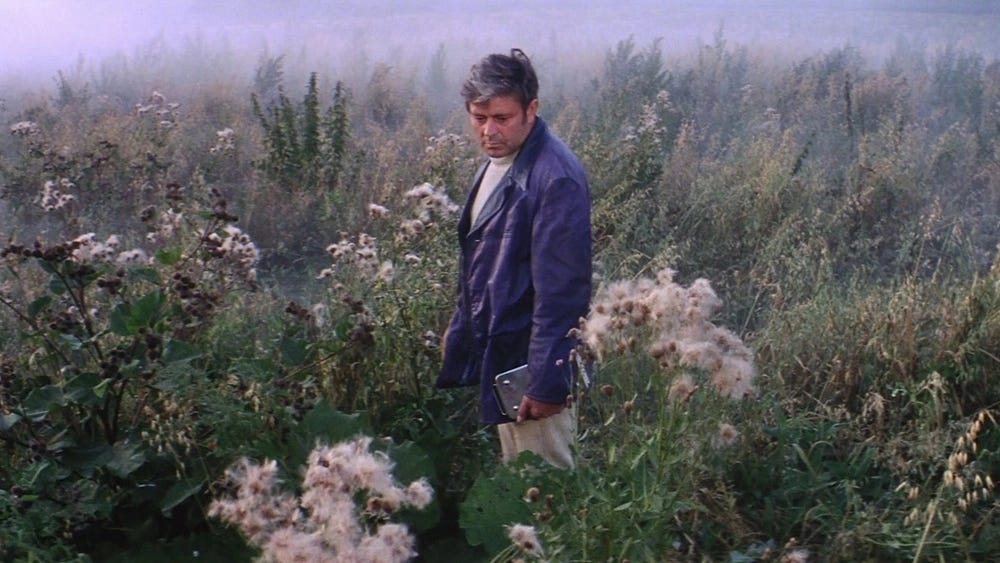

In regards to Mirror, time and memory is explored in a nonlinear, incomprehensible way. The order of events are disorganised, unconventionally structured. Its confusing to follow the narrative, and requires a lot of attention.
Ingmar Bergman

Tehching Hsieh
It challenges the idea that everyday is the same, making it boring and repetitive. Hsieh states that even though he does this single action (over a year), each moment is not the same as before. It is a different day, a different moment of presence. This is represented by the differences of each single photo, that even a single action repeated is never the same as the one before or the one after.
A very simple but time- consuming practice. Documentation can reveal a lot about the past, the time that has passed and the emotion of the exact moment captured in documentation (photos).
Gregor Schneider
Another simple practice, yet very engaging to the audience, especially if you visited the actual site. Gives a sense of deja vu, the feeling of experiencing the exact same moment twice successively (one after the other).
Further reading:
- Review by Craig Garrett https://www.papercoffin.com/writing/articles/schneider.html
Meshes of the Afternoon, 1943
Directed and starred by Maya Deren & Alexander Hammid
There is a lot of repetition and multiple instances of a single person happening in this work. Time is construed and manipulated here, especially since its within a dream too.
Time within dreams are never constant, one minute might feel like a minute, the order of events are non-consecutive/successive, repetition and overlap of time occurs, varying duration- a surreal way of looking at time. Maybe look into time within dreams? How time is perceived in dreams?
Further reading:
- Does Time actually pass slower in Dreams by Kevin Carr https://filmschoolrejects.com/does-time-actually-pass-slower-in-dreams-c89f9435d6e6/
Zbigniew Rybczyński
Another simple practice, with the simple use of editing, masking, repetition and overlapping.
A collage/collection of events that have happened within the room. The continuous layer makes the piece seem more complex. Can see the passing of time, or events within time, all happening in a single moment or shot of the video.
“Thirty-six characters from different stages of life – representations of different times – interact in one room, moving in loops, observed by a static camera. “ – Zbig Rybczynski –Looking to the Future – Imagining the Truth,” in FranÐois Penz, Maureen Thomas, Cinema& Architecture. Mþliús, Mallet-Stevens, Multimedia, BFI, London, 1997
Bruce Nauman
The use of repetition and the scene of the two people being switched, playing the same action.
Simple action yet interesting, how repetition and similar yet different protrayals of the same moment can affect our experience – exploring our individual experience with the ‘aggressive violent’ act.
A Matter of Life Death — Table Tennis Excerpt
A Matter of Life and Death (1946) film
The manipulation of time ie. the pause of time (time still standing) or reverse of time – very easily achieved with video editing.
Futher reading:
- A Matter of Life and Death: The Too-Muchness of It All by Stephanie Zacharek – https://www.criterion.com/current/posts/5815-a-matter-of-life-and-death-the-too-muchness-of-it-all
 Sarah K Obina