Artist Research (continued)
Ceal Floyer
Based in Berlin, Floyer is a conceptual artist that focuses on ‘everyday situations‘ and explores this subject through film and installation. One way she does this is through the use and portrayal of familiar objects i.e. a receipt, curtains, a light switch. She uses these objects to bring about conversations on contradicting notions such as the literal and the imagined, the function and the implication.
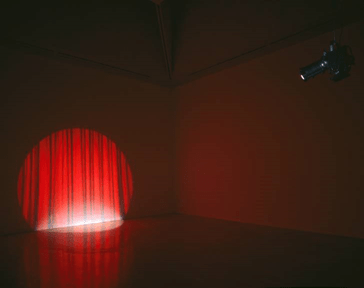
For instance, in her installation work called Double Act (2006), she produces an “anticipation of an event” with a spotlit curtain. However, “as no drama follows, it becomes apparent that the gesture of presenting the curtain and the light is the event”. This alludes to the aforementioned notions as well as giving observers a sense of a familiar situation.
I think this relates to my project because Floyer takes everyday situations and explores it further. I aim to do the same, regarding to time, and routine and daily living etc. I’ve taken the familiar concept of time and began to explore it in a way that challenges our perception of it.
Pablo Valbuena
Similar to Floyer, Valbuena also uses film and installation in his works. However, the main difference is that he focuses on site-specific installation and uses the architecture of ,for instance, a museum, as a part of his work. This is in order to portray the “link between space and time” and also allude to broader concepts such as space, time and perception. From this, Valbuena also incorporates the notions of real and the virtual.
For instance, his work called Para-site (Mattress Factory in 2011) uses projection mapping to explore the concept of space and time. In my work, I also want to use projection mapping to display imagery of time. With this, I am able to bring viewer’s focus to a point where I can influence the viewer’s’ temporal experience.
William Kentridge
Kentridge was born in 1955 in Johannesburg, South Africa and his upbringing in post-apartheid South Africa greatly influenced his work. Therefore, you can denote a sense of history in his works of which he also presents themes such as colonialism, Utopian politics, time and art. He reveals these themes through a range of media such as print, installations, film, tapestry, drawings and so on.
In the late 1980s, Kentridge started making animations and through the 1997 documenta show in Germany, it gained him an international reputation. For his animations, he uses a distinctive stop-method animation where he combines expressionist charcoal drawings with film-making.
His other project called The Refusal of Time (2012) explores the debate on whether time is absolute or is relative. This was influence by the research of Peter Galison who studies Einstein’s theories on relativity, string theory and black holes. He shows this concept through a five channel digital video installation with accompanying sound that lasts for 30 minutes. Alongside the installation, there is a moving sculpture called the “elephant” or “breathing machine” that represents the development of science and industry in the modern era.
I enjoy his unique style of drawings and animation, as well as the process of his in-depth research for his work.
Darren Almond
Based in London, Darren Almond specializes in film, photography, installation and sculpture. He explores the concept of geographical locations, particularly the points of arrival and departure. In regards to the concept of time, Almond resembles the “feelings about the passage of time, themes of personal and historical memory, movement and space“.
His works are typically filmed in inaccessible locations for instance in the Arctic Circle, the Yellow Mountains in South China, British Islands and so on. I think this is to enable the observer to experience a new and uncommon sense of place so that they can immerse themselves into Almond’s work and detach themselves from their own realities.
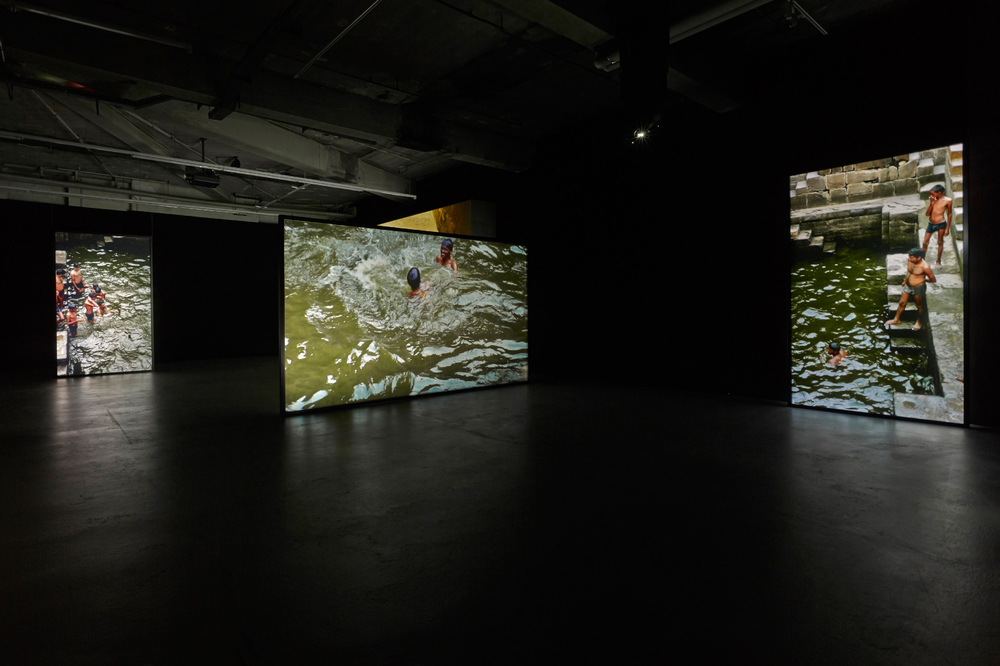
For instance, in his work ‘All Things Pass’ (2012), he reveals a film that was shot in Rajasthan, India which focuses on a step well built in the 9th Century called the ‘Chand Baori’. The film is portrayed through a six channel video installation, each lasting for 30 minutes. It is accompanied with traditional Northern Indian music.
Each of the channels present a combination of various film sequences of the step well at different times of the day and therefore reflects on the “synchronicities which tie together celestial phenomena and terrestrial events” and “the links that exist between the different time scales, thus echoing the position that these notions hold in the conception of time in India. “.
Kahlil Joseph
A Black American film maker, music video director and current Vice-President of The Underground Museum in Los Angeles, Joseph is also known for collaborating with artists such as Flying Lotus, Kendrick Lamar, FKA Twigs, Beyonce, Sampha and more.
Born in Seattle, Joseph was influenced at a young age by the diversity in his community and portrays this in his work. Therefore, there is a strong representation of ‘Blackness’ and ‘Black excellence‘ in his visually-dream like films and of which he uses “American and African imagery to produce work which faces and bodies were the narrative.“.
For instance, in his video installation project ‘BLKNWS‘, he presents video montages of contemporary art, journalism, news and the history of modern art. The videos primarily focuses on Black culture and Black history and was edited to appear like a news program. For instance, it showed an archival footage of Maya Angelou in a 1973 interview.
This was featured in the Venice Biennale’s “May You Live In Interesting Times” artists’ show in 2019 and offers an “antidote to the dangerous representation of black stereotypes pedalled on the mainstream US news“.
Another element of his work is that he emphases on sounds. In an interview with Dazed magazine, he said:
I was inspired by Joseph’s use of video montage in BLKNWS, and will take inspiration for my own project. I want to also use found footage to produce a montage that refers to the history of time etc. Joseph also puts a lot of emphasis on soundscapes in his works, which enhances his videos and the experience of his work. I want to do this with my work too, producing my own sounds and exploring soundscapes in my video installations.
 Sarah K Obina